


The Functional Mushroom Buyer’s Guide: How to Choose the Right Supplier in the Longevity Era

Updated: Apr 3
This practical guide to evaluating functional mushroom suppliers, understanding quality markers, and navigating the evolving longevity-driven ingredient market, has been created in partnership with KÄÄPÄ Biotech.
Over the past few years, the supplement buyer conversation has fundamentally changed. What was once driven by trends, formats, and shelf velocity is now driven by science, traceability, and proof. Now the questions are different. Buyers want to understand the science behind the ingredient. They want to know what they are actually putting in their product, and they want a supplier who can prove it. This guide breaks down how to evaluate suppliers in this new reality.

This shift reflects a broader transformation in the category, directly impacting how ingredient suppliers are evaluated. Longevity, and specifically the idea of healthspan rather than just lifespan, has gained increasing recognition across both scientific and industry discussions, reflecting a growing focus on quality of life and functional longevity, driven by increasing consumer demand for healthy aging solutions [1,2].These biological processes are widely recognised in public health and scientific literature as central drivers of aging and disease risk [3,4].
People are not just looking to live longer. They want to stay metabolically sharp, physically resilient, and cognitively present throughout their lives. That demand is landing directly on the desks of product developers and supplement buyers, and it is changing what ingredient suppliers need to deliver. This demand is further reinforced by global demographic shifts and increasing consumer focus on preventive health strategies and healthy aging [5,6].However, it also changes the criteria buyers should use when selecting those suppliers.
Why Healthspan Science Matters for Ingredient Development
The biology of ageing is complex, but researchers have identified a set of recurring processes often referred to as the hallmarks of ageing that influence how cells and organs function over time. These factors include mitochondrial dysfunction, chronic inflammation, oxidative imbalance, and what researchers call stem cell exhaustion. This last condition refers to the gradual loss of the body's ability to regenerate and repair tissues. These are measurable biological targets that allow ingredient developers to assess efficacy and differentiate formulations with real scientific backing [7].

These systems provide measurable biomarkers, allowing researchers to evaluate how ingredients influence mitochondrial function, oxidative balance, and cellular resilience. They can examine changes in mitochondrial activity, oxidative balance, and the number of stem cells in circulation as indicators of how well cells can withstand stress.
This is the framework that makes functional mushrooms scientifically interesting for longevity-positioned products. Species like Chaga (Inonotus obliquus) contain complex arrays of bioactive compounds, such as betulinic acid and inotodiol, phenolic compounds, and triterpenes, that have been studied in relation to oxidative stress, inflammatory signalling, and cellular stability. This is why functional mushrooms are increasingly selected for high-quality, longevity-focused formulations.
Chaga has become a subject of increasing scientific interest. A preliminary clinical investigation published in Functional Food Science explored the effects of a formulation containing Chaga extract and other plant-derived compounds on biomarkers linked to stem cell function and mitochondrial activity [8].

The study reported that individuals receiving Chaga, who demonstrated robust effects across multiple stem cell types, including an average ~36% increase in endothelial stem cells, alongside modulation of mitochondrial stress-related parameters such as membrane potential and volume compared to placebo [8].
While these findings are still early-stage, they reflect the type of emerging evidence that is beginning to shape ingredient evaluation in the longevity space. For these brands, that evidence base is becoming a commercial requirement, not just a nice-to-have.
How to Choose the Right Functional Mushroom Ingredient Supplier
Based on Kääpä Biotech's experience working with supplement brands and product developers, one question consistently comes up in conversations with product developers and procurement teams:
How do I actually choose the right supplier?
It is a fair question because the functional mushroom ingredient market is genuinely difficult to navigate from the outside. Quality varies enormously, marketing language is often indistinguishable from technical terms, and the gap between what is labelled and what is actually in the product can be significant. Here is how to cut through it.
1. Fruiting Body vs. Myceliated Grain
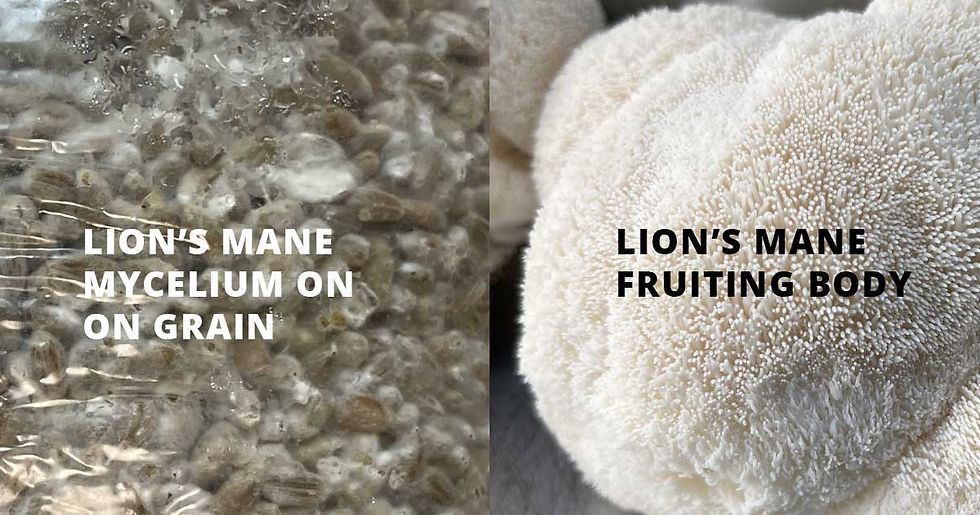
This is the first question to ask any supplier, and the answer tells you a lot. Mushroom fruiting bodies, the actual mushroom, contain the bioactive profile characteristic of each species. Key compounds such as Hericenones/Hericenes, triterpenes, phenolic compounds, and other structurally diverse metabolites are concentrated in this part of the organism, contributing to its functional properties.
Mycelium grown on grain substrate is a different product. It is cheaper to produce, but it frequently contains significant amounts of residual grain starch, and the bioactive content is much harder to verify.
Many products on the market use myceliated grain but market themselves as mushroom supplements. If a supplier cannot clearly confirm they are working with fruiting bodies and document it analytically, this should be considered a critical risk indicator.
2. Extraction Method and Ratio Transparency
Raw mushroom powder and extracted mushroom ingredients are fundamentally different. Extraction is used to concentrate specific bioactive compounds and remove non-functional material. The effectiveness of this process depends entirely on the method used. Different compound groups require different extraction approaches.

A supplier should be able to clearly explain their extraction method, including solvents, process, conditions and standardisation strategy. If this cannot be articulated in technical terms, it is unlikely to be controlled or consistent.
Extraction ratios are often used as a marketing claim, but without context they can be misleading. A 10:1 extract may sound impressive, but only if the starting material is of high quality and the process is standardised and reproducible. In practice, extraction ratios alone provide limited insight into the functional value of an ingredient.
What ultimately matters is the composition, bioavailability, and consistency of the final extract. For this reason, more advanced extraction approaches focus on releasing and preserving the full spectrum of bioactive compounds while ensuring batch-to-batch reproducibility.
For example, KÄÄPÄ Biotech’s NordRelease® extraction is designed to break down the chitin cell structure of the mushroom, improving the bioavailability of compounds and preserving the full bioactive profile, rather than relying on simplified ratio-based claims
3. Bioactive Compound Verification
The only reliable way to know what is actually in an ingredient is through analytical testing. In the functional mushroom category, not all analytical methods are equal, and the way bioactive compounds are measured matters.

Buyers should request a Certificate of Analysis (CoA) supported by validated analytical methods, covering both general compositional markers and, more importantly, species-specific bioactive compounds. While some suppliers continue to emphasise beta-glucan content as a primary quality indicator, this alone does not reflect the full functional profile of a mushroom extract. The compounds responsible for the desired biological effects are often species-specific and require targeted analytical verification. This data should always be batch-specific, not a generic or representative document. If a supplier cannot provide this clearly and consistently, or provides it reluctantly, that tells you everything you need to know about how seriously they take quality.
4. Certifications and Traceability
Relevant certifications, such as organic, along with heavy metal testing, microbial safety, and country of origin documentation, are baseline requirements for any serious ingredient supplier. This may also include standards such as FSSC 22000, depending on the level of quality assurance required. However, traceability goes beyond certifications. Can the supplier tell you where the mushrooms were grown, under what conditions, and how the raw material was handled before extraction? This includes visibility into cultivation methods, environmental conditions, and post-harvest processing. In a category where supply chains are often opaque, this level of transparency is genuinely rare and a strong indicator of a high-quality supplier.

5. Delivery Format Compatibility
Not all mushroom extracts perform equally across different delivery formats. Factors such as particle size and stability can significantly impact performance. An ingredient that performs well in a capsule may behave differently in a functional beverage, powder blend or a gummy format. A qualified supplier should be able to provide formulation data across multiple delivery formats and will be able to advise on how their ingredient performs in your developments, rather than simply supplying a raw material without application support.
What the Market Is Telling Us Right Now
The trends in the functional mushroom supplement category are moving in a consistent direction. Buyers are consolidating around fewer, more reliable and technically validated suppliers. The brands that are growing faster are the ones that can make specific, credible ingredient claims, not because they are making health promises to consumers, but because they have built their products on a foundation of analytical verification and documented quality.

Longevity and healthy aging remain one of the fastest-growing positioning territories in functional nutrition, driven by shifting consumer priorities and increasing demand for proactive health solutions [9]. Chaga, alongside Lion's Mane and Reishi, is increasingly being incorporated in premium formulations targeting cellular resilience, cognitive performance and metabolic health.
The delivery formats expanding most quickly are functional beverages, high-specification capsule supplements, and condition-specific stacks that combine multiple ingredients with a defined rationale [10].
What is declining is the undifferentiated end of the market commodity powders, vague wellness positioning, and ingredients that cannot withstand technical scrutiny from increasingly sophisticated buyers.
How KÄÄPÄ Biotech aligns with Buyer Expectations
KÄÄPÄ Biotech partners with product developers and procurement teams who prioritise quality, consistency, and scientific validation. Their extracts are produced from certified fruiting bodies and processed using their proprietary NordRelease® extraction technology. Each batch is analytically verified for bioactive content, ensuring consistency, traceability, and reproducibility.

We provide comprehensive technical documentation, including batch-specific certificates of analysis, traceability records, extraction data, and formulation support across delivery formats. This allows their partners to make informed decisions across R&D, regulatory, and product development processes.
For brands operating in the longevity and functional nutrition space, we act as an ingredient partner rather than just a transactional supplier: supporting R&D decisions, regulatory preparation, and long-term product development.
The supplement buyer conversation has evolved. The suppliers who will remain relevant are those who can consistently demonstrate quality, transparency, and scientific credibility.
References
1. Wiles T. Rethinking longevity: Shifting the focus from lifespan to healthspan. Vitafoods Insights. 2025. Available at: https://www.vitafoodsinsights.com/healthy-ageing/rethinking-longevity-shifting-the-focus-from-lifespan-to-healthspan
2. World Health Organization. Decade of healthy ageing: Baseline report. Geneva: WHO; 2021. Licence: CC BY-NC-SA 3.0 IGO. Available at: Decade of healthy ageing: baseline report
3. World Health Organization. Ageing and health. 2025. Available at: https://www.who.int/news-room/fact-sheets/detail/ageing-and-health
4. Gianfredi V, Nucci D, Pennisi F, et al. Aging, longevity, and healthy aging: the public health approach. Aging Clin Exp Res. 2025. Available at: https://doi.org/10.1007/s40520-025-03021-8
5. Zhang Y, Gu Z, Xu Y, et al. Global scientific trends in healthy aging. Heliyon. 2024;10:e23405. Available at: https://doi.org/10.1016/j.heliyon.2023.e23405
6. Garmany A, Terzic A. Healthspan-lifespan gap across regions. Commun Med. 2025;5:381. Available at: https://doi.org/10.1038/s43856-025-01111-2
7. López-Otín C, Blasco MA, Partridge L, et al. The hallmarks of aging. Cell. 2013;153:1194–1217. Available at: https://doi.org/10.1016/j.cell.2013.05.039
8. Jensen, G.S., Sanchez, K., Cruickshank, D. and Fields, C. (2026). Methodology for testing the efficacy of functional botanical ingredients for support of stem cell surveillance and mitochondrial resilience: A preliminary randomized, double-blind, placebo-controlled, acute clinical proof-of-concept trial. Functional Food Science, 6(1), pp.27–50. Available at: https://doi.org/10.31989/ffs.v6i1.1882
9. Eastlake D. Longevity and weight loss redefining consumer priorities. FoodNavigator. 2025. Available at: https://www.foodnavigator.com/Article/2025/11/12/longevity-and-weight-loss-drive-food-and-beverage-innovation/
10. Smith A, Rubino J. Top 10 natural product trends for 2026. New Hope Network. 2025. Available at: https://www.newhope.com/natural-product-trends/10-natural-product-trends-taking-over-shelves-in-2026


