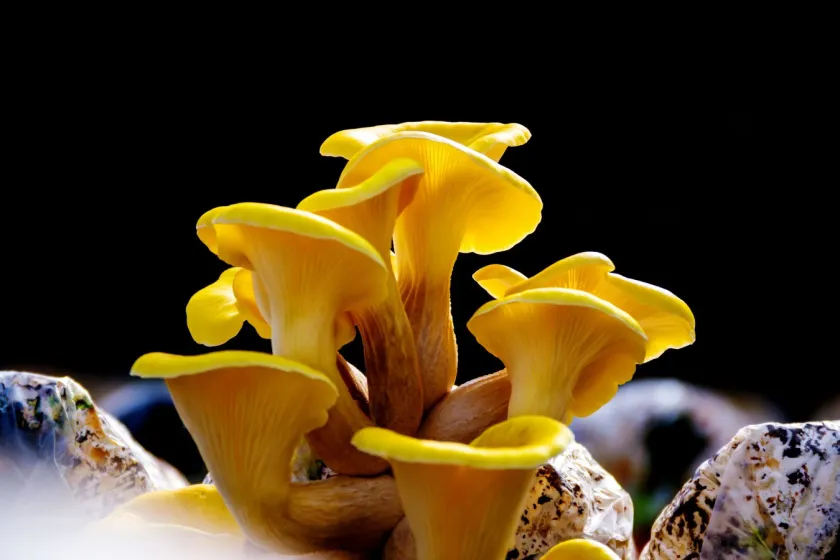
Shiitake Mushrooms Could Turn Wood Waste Into Renewable Fuel

Too long to read? Go for the highlights below.
Growing shiitake mushrooms on hardwood breaks down nearly half of wood's tough structural barriers, preparing it for efficient conversion to biofuel—achieving over 80% of the maximum possible ethanol yield
Unlike harsh chemical treatments that generate toxic compounds, the biological by-products from mushroom cultivation do not interfere with fuel production, simplifying the process
The global shiitake industry produces 12.5 million tonnes of leftover substrate each year; this research suggests farmers could harvest edible mushrooms first, then convert the waste into renewable ethanol
A biological alternative to chemical pretreatment
The global push towards renewable fuels has placed cellulosic ethanol—a biofuel derived from the structural fibres of plants rather than food crops like corn—at the forefront of bioenergy research. Produced by breaking down plant biomass and fermenting the released sugars, this second-generation biofuel offers a pathway away from fossil fuel dependence. Yet a persistent bottleneck remains: pretreatment.
Wood and other plant materials are built from a tough composite of cellulose (the sugar-rich fibre that can be converted to ethanol), hemicellulose (a related structural carbohydrate), and lignin (a rigid polymer that acts like biological cement, holding everything together). Before enzymes can access the cellulose locked within woody materials, these protective barriers must be dismantled. Conventional thermochemical methods—using heat, pressure, and acids or alkalis—achieve this effectively but generate toxic by-products that poison the yeast responsible for fermentation.

A study published in Industrial Crops & Products by researchers from Anhui Agricultural University, the University of Inland Norway, Umeå University, and the Swedish University of Agricultural Sciences demonstrates that shiitake mushroom (Lentinula edodes) cultivation offers a compelling biological alternative. The research reveals that growing shiitake on hardwood substrates achieves substantial breakdown of these structural components whilst producing by-products with minimal impact on fuel production efficiency.
Degradation patterns and by-product formation
The investigation tracked compositional changes across the shiitake cultivation cycle. Over 75 to 81 days, the fungus degraded 42.6% of lignin, 47.6% of xylan (the main sugar in hemicellulose), and 43.1% of glucan (the building block of cellulose) in the hardwood substrate. Degradation patterns varied with growth stage: lignin and xylan broke down rapidly during the first 63 days of mycelium colonisation, whilst glucan degradation accelerated during the fruiting phase when the mushroom channels energy into producing its edible caps.

Using advanced chemical profiling, the researchers identified over 1,000 small molecules across cultivation stages. The analysis revealed that shiitake selectively consumes certain degradation products for its own growth, whilst others accumulate as pretreatment by-products. These included compounds such as (L)-dehydroascorbic acid, triglochinic acid, and 5-hydroxy-2-methylchromone. Importantly, common inhibitors generated by thermochemical methods—furfural and hydroxymethylfurfural (compounds notorious for killing yeast) and aliphatic carboxylic acids—were either absent or present only at trace levels.
Fermentation performance exceeds expectations
Following shiitake cultivation, the researchers treated the spent substrate with commercial enzymes to release sugars from the remaining cellulose—a process called enzymatic saccharification. This achieved 58.8% glucan digestibility, meaning nearly 60% of the available cellulose was successfully converted to fermentable sugars. That figure represents approximately a 30-fold improvement over untreated raw material.
The sugar-rich liquid was then fermented using Saccharomyces cerevisiae—common brewer's yeast—yielding ethanol at 83.4% of the theoretical maximum. In practical terms, this translates to 42.6 grams of ethanol per 100 grams of glucose consumed, approaching the chemical limits of what fermentation can achieve.

This performance aligns with results from optimised thermochemical approaches. Dilute acid pretreated corn stover typically achieves 80–90% of theoretical yields, whilst steam-exploded materials reach similar levels. The shiitake method matched these benchmarks without the associated inhibition challenges.
Water extraction experiments provided further evidence that by-products pose limited concerns. Removing water-soluble compounds from the substrate prior to enzyme treatment did not improve sugar release or ethanol yield. Indeed, the water-extracted material showed slightly lower fermentation performance, possibly because the washing removed nitrogen-rich mycelial components—essentially fungal protein—that helped nourish the yeast during fermentation.
Implications for circular bioeconomy
The findings carry particular significance for waste valorisation strategies. Shiitake ranks as the world's most cultivated mushroom, with global production generating approximately 12.5 million tonnes of spent mushroom substrate annually. This material has traditionally been discarded or combusted, representing a substantial untapped resource.
The approach aligns with emerging circular economy models in the mushroom industry, where waste streams are repurposed rather than disposed. By integrating food production with biofuel generation, shiitake cultivation could enhance the economic viability of both enterprises—farmers harvest valuable mushrooms, then convert the leftover substrate into renewable fuel.
Future optimisation pathways
Certain limitations warrant attention. The glucose concentrations achieved in the sugar solutions—16 to 20 grams per litre—fall below the 100 grams per litre threshold recommended for industrial-scale high-gravity fermentation, where concentrated sugar feeds enable efficient, cost-effective ethanol production. Achieving commercial scalability will require optimising shiitake strains and cultivation conditions to maximise lignin and hemicellulose degradation whilst preserving the cellulose that serves as the sugar source.
Previous research using different shiitake strains on single-species hardwoods has achieved cellulose digestibility exceeding 92%, suggesting considerable room for improvement. Controlled enzyme dosing and tailored feeding strategies during high-solids processing—essentially working with thicker slurries to concentrate sugars—may further enhance glucose concentrations.
The research establishes that fungal pretreatment via shiitake cultivation presents a viable route to cellulosic ethanol production, circumventing the inhibition challenges that have long complicated thermochemical approaches. Whether the mushroom industry can leverage this potential at commercial scale remains to be demonstrated.