Roots & Remains: Mycelium, Memory & Environmental Justice in Cleveland
At the Cleveland Public Library’s Rice Branch, a new mycotectural exhibit called Roots & Remains: Legacy in the Land is inviting residents to share their lived experiences with environmental injustice — from contaminated soil to aging housing stock to the effects of industrial decline – and discusses how fungi could be a solution.
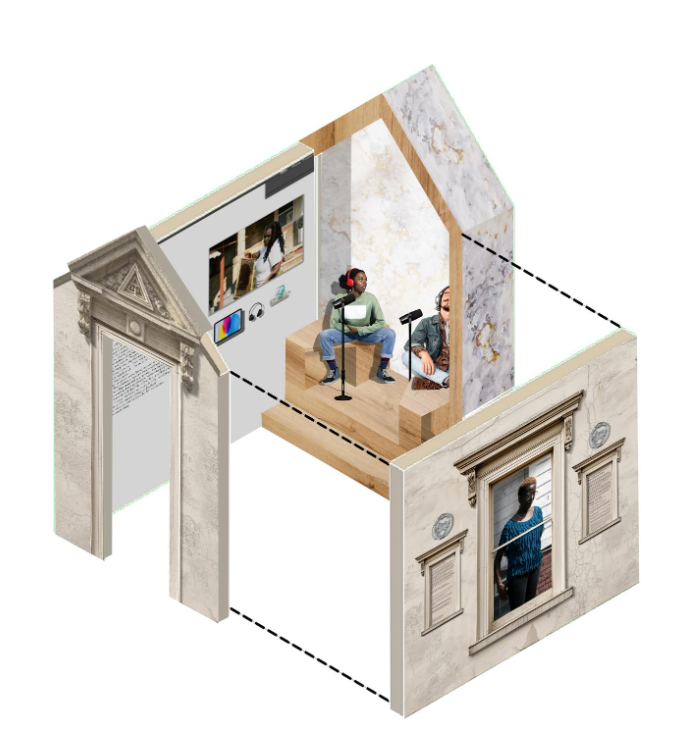
At the center of the installation is a recording booth built entirely from mycelium. The structure itself is a demonstration of what fungi can do: form strong, insulating, fire-resistant composites while storing carbon and using almost no embodied energy. Inside this mycelium booth, community members can sit down and record stories for Ideastream Public Media, creating a growing archive of environmental memory and neighborhood history.
Environmental Justice in Cleveland
Cleveland has long faced the layered challenges of environmental injustice — lead contamination, brownfields, legacy industrial pollutants, and disinvestment in predominantly Black and low-income neighborhoods. These issues shape everyday life: they influence health outcomes, restrict the safe use of land, and limit generational opportunity.

Roots & Remains does not present these problems abstractly. It asks residents to narrate their own histories, making environmental injustice personal, place-based, and urgent.
Why Mycelium Belongs in This Conversation
Biocycler is process developed by Roots and Remains architect Christopher Maurer that leverages fungi to remediate as it recycles demolition waste. Fungi offer a powerful model for imagining environmental repair through several well-established mechanisms relevant to polluted soil and waste:
Enzymatic Action: Many fungi secrete enzymes capable of breaking down complex organic pollutants — such as petrochemicals — into simpler, less harmful compounds.
Biosorption: Fungal cell walls (rich in chitin and glucans) can bind heavy metal ions, removing them from water or soil systems through passive chemical attraction.
Biochelation: Some fungi produce organic acids and other compounds that bind metals into stable, less bioavailable forms.
These processes are already used in research labs and pilot projects worldwide. They show how fungi could help transform contaminated land, legacy waste, or construction debris into cleaner and safer material flows.
Aspirations: Remediate as We Recycle
While Roots & Remains is primarily a storytelling project, it also points toward a broader vision emerging in Cleveland and beyond:
Can we design systems where recycling and remediation happen at the same time?
Instead of sending contaminated wood, soil, or demolition debris to landfills — could fungi help detoxify it and convert it into new, carbon-storing materials?Instead of treating community contamination only as a hazard — can it become part of a regenerative loop?
This is the aspiration behind current fungal research: a future where communities most impacted by environmental harm also benefit first from regenerative biotechnologies.

About the Author:
This post was written by Chris Maurer, architect and founder of redhouse studio, whose work explores regenerative architecture, mycotecture, and bioremediation.
Read his other article: World’s first structural mycotectural building, Mycotecture Off-Planet