


VTT's Pulp-Based Mycelium Leather Method Unlocks Large-Scale Production

Researchers at the VTT Technical Research Centre of Finland have developed a fermentation-based method to produce mycelium leather at industrial scale, demonstrating the process by sewing a prototype handbag from the material.
The technique grows the fungus Trichoderma reesei in submerged fermentation tanks, then blends the harvested pulp with sorbitol and cellulose to create sheets with tensile strength comparable to conventional leather.
The breakthrough could accelerate fashion and automotive industries' shift away from animal-derived and synthetic leathers, both of which carry substantial environmental costs.
A Scalable Problem in Sustainable Fashion
Mycelium leather, made from the thread-like root structures of fungi, has attracted serious interest from fashion and automotive companies seeking alternatives to conventional hide. In June 2026, Italian luxury house Bottega Veneta released a limited-edition accessories line produced in partnership with eco-materials startup Ephea, signalling genuine appetite from legacy brands. Yet the launch also highlighted a persistent constraint: production volumes remain too small for broad commercial adoption.

The dominant manufacturing method involves letting fungi spread across trays until their fibres knit into a solid sheet. VTT researchers describe this tray-based approach as unsuitable for mass production, which has kept mycelium leather confined to limited runs and premium niches.
A Fermentation Route to Industrial Scale
The VTT team, backed by Business Finland and the Research Council of Finland, pursued a different path. Rather than growing fungi across flat surfaces, they submerged Trichoderma reesei in a nutrient-rich liquid inside fermentation tanks similar to those used in brewing. The same fungal strain is used by precision fermentation companies Perfect Day and Onego Bio, a VTT spinout, to produce recombinant whey and egg proteins respectively, so the infrastructure is already well understood by the biotech industry.

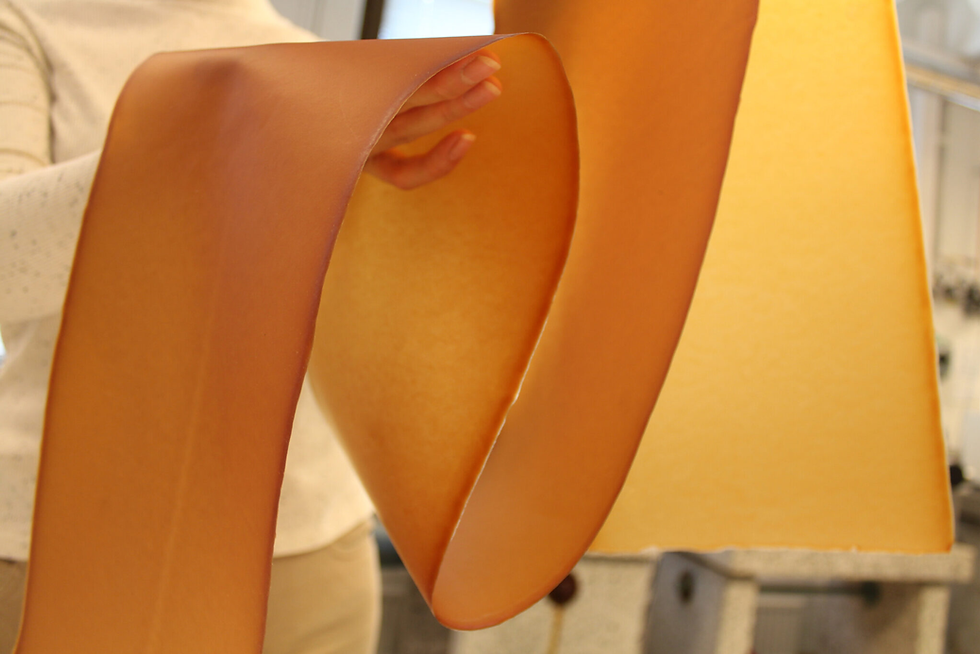
The submerged fermentation process caused the fungus to grow into a thick, pulp-like mass. Researchers harvested and washed this material, then blended it with sorbitol, a natural sugar alcohol used in foods and cosmetics, and cellulose, the main structural component of plant cell walls. This combination was designed to improve the material's flexibility and strength. The mixture was then spread into thin sheets and dried to form a non-woven fabric.

To move beyond small lab samples, the team used a roller system resembling those found in paper manufacturing to produce continuous large sheets, which were ultimately sewn into a prototype handbag. As Manuel Arias-Barrantes from VTT noted, the work addressed a significant bottleneck in enabling large-scale, affordable production of mycelium-based fabrics.

Lab tests, published in ACS Applied Bio Materials, found that the rolled mycelium sheets achieved tensile strengths comparable to conventional leather, and that the material decomposed in water within 28 days and fully disintegrated under industrial composting conditions in approximately six weeks.
Why Conventional and Synthetic Leathers Fall Short
The environmental case for an alternative is substantial. Conventional cow leather produces around 110 kg of CO2-equivalent per square metre and is linked to deforestation, biodiversity loss, and hazardous tanning chemicals. Synthetic leather, derived from petrochemicals, reduces that carbon footprint to roughly 15.8 kg per square metre, but introduces other problems: microplastic shedding, aquatic harm, and a decomposition timeline of 20 to 500 years. Plastic production is also responsible for 3.4% of global emissions, according to the source material.
Limitations and the Road Ahead
The VTT researchers were candid about what remains unresolved. The material still needs to become more tear-resistant before it is ready for consumer products. The authors noted, however, that the manufacturing process is promising partly because it relies on equipment already common in biotech and printing industries, which should ease eventual scale-up.
Other companies pursuing mycelium leather, including US-based Ecovative, MycoWorks, and Mushmycel, are working on parallel innovations, while cellular agriculture firms such as Faircraft and Cultivated Biomaterials approach the problem differently. The VTT method is notable for its use of existing industrial infrastructure and its demonstrated control over the final material's properties, including the ability to adjust colour, texture, and layering. Whether those advantages translate into commercial viability will depend on closing the remaining performance gap.


