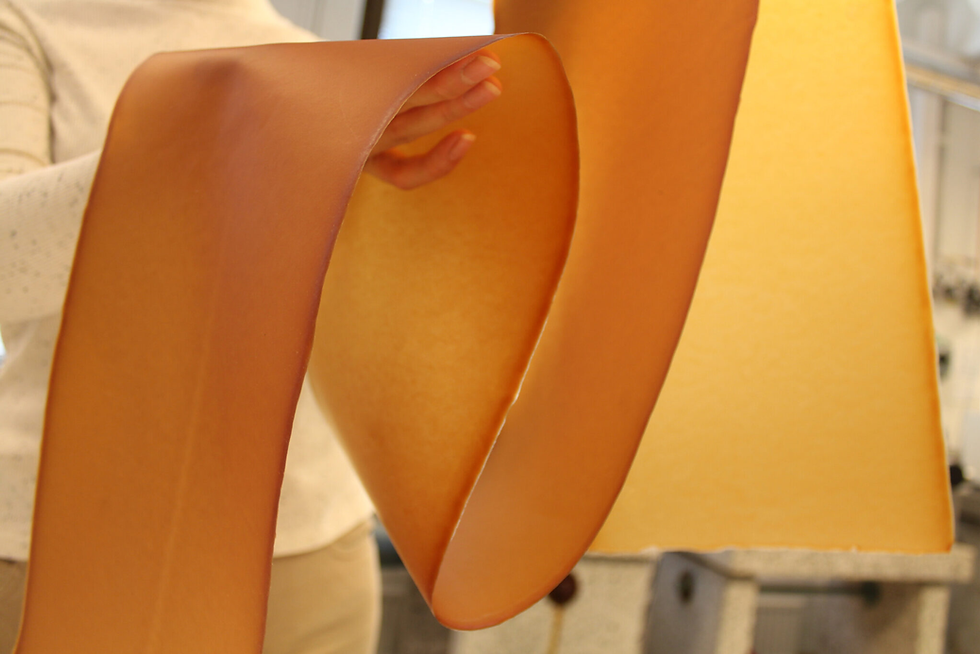
University of Vienna Turns Mushroom Waste Into Sewable, Recyclable Leather Alternative

Researchers at the University of Vienna produced flexible leather-like sheets from Agaricus bisporus mushroom processing residues using papermaking methods, achieving tensile strengths up to 20 MPa and tear strengths of 104–107 N/mm when reinforced with woven lyocell fabric.
The material is built from chitin-glucan complexes extracted from mushroom waste via alkaline treatment, bypassing the slow, contamination-prone mycelium-growth methods used by legacy commercial producers such as Bolt Threads and MycoWorks.
If scalable, the approach could offer the fashion industry a genuinely circular leather substitute: bio-based, biodegradable, recyclable over at least five cycles, and already worn at Berlin Fashion Week.
A Waste Stream With Structural Potential
The global leather goods market was estimated at US$261.5 billion in 2023, according to Global Market Insights, and is forecast to grow at 6.3% annually through 2032. That scale carries significant environmental costs: producing one square meter of bovine-finished leather requires up to 370 litres of water, according to a 2024 review in the Journal of Industrial Ecology, and the tanning process generates substantial solid and liquid waste. Commercial mycelium-based alternatives, including Reishi from MycoWorks and Mylo from Bolt Threads, have aquaired considerable investment but have struggled to scale up. Bolt Threads, despite raising US$300 million in funding, paused Mylo production in 2023, citing an inability to scale viably.

A team led by Alexander Bismarck and Mitchell P. Jones at the University of Vienna's Polymer and Composite Engineering (PaCE) Group, working with Kathrin Weiland at the University of Applied Sciences Technikum Wien, has published a study in Cleaner Materials proposing a different route: using mushroom processing residues rather than purpose-grown mycelium.
From Discard to Chitin-Glucan Sheet
The process begins with Agaricus bisporus fruiting body waste, including misshapen mushrooms, stem off-cuts, and cap trimmings, supplied by Grünewald International Mainfrucht GmbH, which generates approximately 10,000 tonnes of such residues annually. The material is washed, blended, and treated with sodium hydroxide (NaOH) to remove proteins and lipids, isolating the chitin-glucan complex, a natural composite of two structural biopolymers found in fungal cell walls. The resulting pulp is then processed into sheets using methods analogous to conventional papermaking.

Two variants were produced: "hard" leather alternatives, and "soft" suede-like alternatives. using 0.1 M NaOH. Plasticisation with glycerol reduced tensile strength but increased flexibility, with strains-to-failure reaching 16–18%, comparable to the lower bounds of synthetic polyurethane leather (15–60%).
Sewability, critical for garment construction, was achieved by hybridising the sheets with woven lyocell fabric from Lenzing AG. Unhybridised sheets tore when stitched; hybridised versions achieved tear strengths of 104–107 N/mm, exceeding the team's bovine leather reference (27 N/mm) and falling within the published range for bovine leather (42–106 N/mm).
A Corsage at Berlin Fashion Week
Designer Marlene Raymakers, working with the PaCE Group, produced a corsage from the dyed, hybridised material, which was worn by six models at seven events, including runway shows and outdoor appearances, accumulating approximately 4–6 hours of total wear time. The material survived repeated use with only minor rips, which were easily repaired. Wearers described the haptics as comfortable, with a "cooling touch." Two years after fabrication, the corsage retained its flexibility and colour.

Bleaching with hydrogen peroxide and dyeing with natural pigments, including turmeric, indigo, carrot, and aronia extract, produced a range of stable colours. Colour fastness after water immersion scored 3.4–4.9 on a five-level grey scale, with visible colour transfer to adjacent textiles observed only for indigo and turmeric.
Recyclability was demonstrated over five cycles: failed test specimens were repulped and reformed into new sheets with tensile strengths of 14–23 MPa, broadly comparable to the original 20 MPa.
Limitations and the Road Ahead
The authors identify several unresolved challenges. Plasticised sheets absorb substantially more moisture at high relative humidity than bovine leather, which could affect performance in wet conditions, though a biobased coating reduced this. Batch-to-batch variation remains a concern, and full life-cycle assessment has not yet been conducted. The authors also note that glycerol leaching under varying weather conditions requires further investigation. Mitchell Jones, Kathrin Weiland, and Alexander Bismarck hold a pending patent for the fungal leather alternative, assigned to Mycori AG, which the authors disclose as a potential competing interest. Broader commercial viability will depend on process automation, formulation optimisation, and production standardisation.

For a sector where the tension between mycelium materials innovation and scalable manufacture has stalled multiple ventures, the Vienna group's papermaking approach offers an architecturally different path, one grounded in existing industrial infrastructure rather than in novel bioreactor design.