Open Access: Artist Builds Functional Ocean Kayak Entirely from Cultivated Mushroom Mycelium

Too long to read? Go for the highlights below.
Artist Sam Shoemaker successfully paddled a 12-foot kayak constructed from Ganoderma polychromum mycelium composites across the Catalina Channel in California, covering 26 miles in 12 hours
The artist just made all of his mycelium composite research open access.
The project required nine weeks of incubation inside a fiberglass form, with the final structure weighing 106 pounds and shrinking 20% during the drying process
When an artist paddled a mushroom boat across the open ocean, few believed the endeavour would succeed. Yet on 5 August 2025, Sam Shoemaker completed a 26-mile crossing of California's Catalina Channel in a vessel constructed entirely from mycelium composites—the fruiting body networks of cultivated fungi bound with agricultural waste.
The undertaking represents more than artistic ambition. It demonstrates practical applications of fungi-based materials that could eventually address industrial reliance on plastics, foam, and concrete. Mycelium composites leverage white-rot fungi to convert agricultural byproducts and waste streams into structural materials capable of replacing synthetic alternatives.
More importantly, the artist just released a 94-page compendium, Building with Mycelium Composites: Strategies for Aquafung and Material Design. It is the first open-source guide dedicated to building with living mycelium composites, available for free to download and print. It brings together a decade of research into practical, field-tested methods for new and experienced cultivators alike.

From Proof of Concept to Open Water
Shoemaker's journey began with Mushroom Boat 1, a prototype kayak constructed in 2023 using a second-hand fishing kayak as a mould. That vessel, weighing 72 pounds and measuring roughly 10 feet, entered open water in June 2024. Testing revealed significant limitations: the boat sat too low in the water, bent upward at both ends, and proved difficult to control in wind. Critically, it demonstrated that mycelium composites could survive aquatic conditions without immediate structural failure.

These findings informed Mushroom Boat 2, engineered specifically for ocean conditions. The second iteration measured 12 feet in length and weighed 106 pounds—a 34-pound increase achieved through additional material rather than design modifications. The boat featured a V-shaped keel borrowed from surfboard design, improving hydrodynamic tracking. Importantly, the fiberglass form was scaled to account for anticipated shrinkage, as mycelium composites typically lose 18-20% of their volume during drying.
Substrate Selection and Fungal Collaboration
Both vessels utilised Ganoderma polychromum, a wild polypore species collected near Shoemaker's Los Angeles studio.

This species belongs to the Ganoderma genus, which remains the most viable option for structural applications due to its strength, resilience, and capacity to survive temperatures between 95°F and 122°F (35°C to 50°C). Ganoderma possesses unique adaptability: it can survive extended dormancy and revive after desiccation—properties essential for materials intended to endure environmental stress.
The substrate combined hemp hurd (59%), oak sawdust (20%), wheat flour (4%), guar gum (8%), psyllium husk (8%), and gypsum (1%). Hemp hurd provides hydrophobicity through waxy surface compounds that reduce water uptake compared to sawdust. The added binders—guar gum and psyllium husk—modified the substrate's rheology into a dough-like consistency, encouraging stronger hyphal threads to weave the composite together.
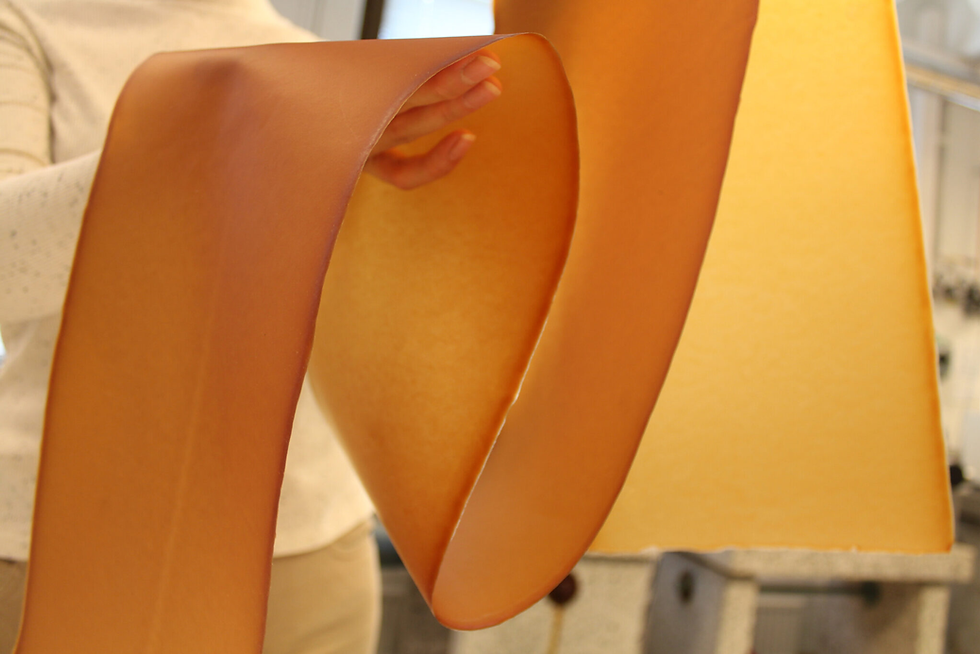
Textile reinforcements proved crucial. Cotton stockinette tubing and muslin sheets were hydrostatically pre-treated, sterilised, and colonised alongside bulk substrate before being incorporated into the growing boat. These textiles created an inseparable bond with mycelium during colonisation, dramatically improving the composite's ductility and flexural strength—properties essential for absorbing shock from ocean swells.
Performance and Preservation
The crossing itself revealed both capabilities and limitations. After 12 hours paddling through Catalina Channel conditions—including cross-swells, currents, and commercial shipping traffic—the boat gained merely 3 pounds of water weight. Within days of drying, that moisture evaporated and the structure regained its original condition.

Preservation remains an evolving challenge. Laboratory tests comparing various sealants showed shellac provided optimal performance, limiting water absorption to 12% after 23 days of saltwater immersion, compared to 35% for uncoated samples. Beeswax and soy-based coatings offered marginal improvements. Insect infestation—a detail rarely discussed in mycelium material science—emerged as potentially more problematic than decay, requiring careful consideration of how to protect biodegradable structures without compromising their environmental credentials.
The crossing demonstrated that mycelium composites merit serious investigation as material alternatives. Yet scaling this technology remains uncertain. Shoemaker acknowledges the boat was "highly impractical"—heavier, slower, and more labour-intensive than conventional kayaks. Industrial applications will require institutional backing, systematic research, and solutions to production challenges that remain largely unresolved.