ColorFun Moves Blue and Orange Fungal Dyes Towards Larger-Scale Production

The ColorFun project, led by MNEXT, has planned a larger-scale fermentation of a blue fungal dye and is preparing production of orange dyes.
The dyes are made by fungi through fermentation of biobased raw materials, and the project studies production, extraction, purification and application together.
First application tests with NPSP in biobased composite panels have flagged colour intensity and purification as areas needing work, showing what must be solved before the dyes leave the laboratory.
Why Fungal Dyes Are Being Pursued
Colourants appear in a wide range of products, but MNEXT notes that they are still often made from fossil raw materials or through processes that demand a great deal of energy, water and chemicals. Fungi offer an alternative. Through fermentation, in which microorganisms convert feedstock into useful compounds, they can produce colourants from biobased raw materials.
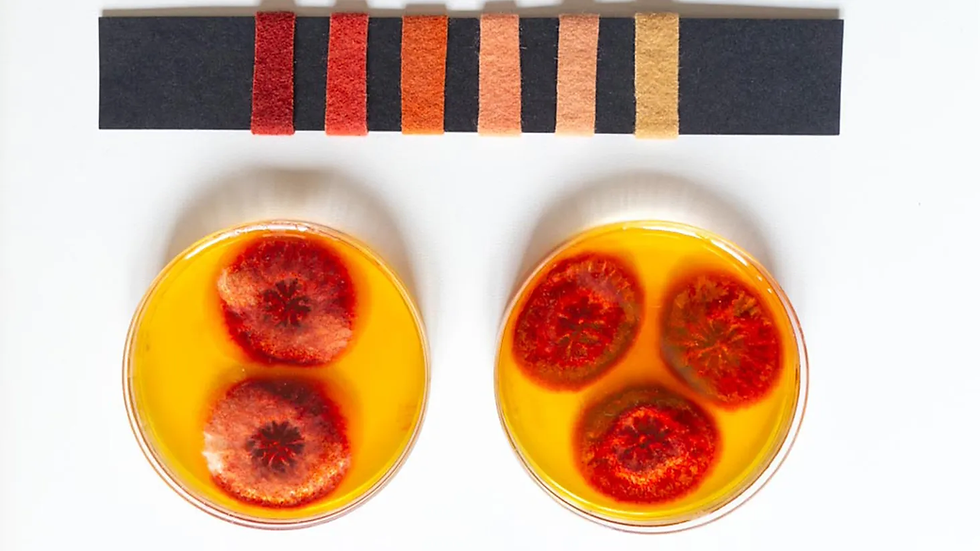
The difficulty is producing these colourants reliably and efficiently, then purifying them and making them suitable for different uses. ColorFun therefore looks at the full chain rather than at colour production alone. Earlier work on pigments from fungi was previously conducted, extracting colour derived from mushrooms.
Scaling Up Blue and Orange
A fermentation of the blue dye at a larger scale is scheduled for the coming period, and production of the orange dyes is being prepared further. MNEXT says scale-up serves two purposes. It yields more material for follow-up research and application tests, and it shows how the production process behaves at larger volumes.
Extraction, purification and formulation are also being optimised. The aim is to establish how the dyes can be produced and processed efficiently and consistently.
Jasper Meijer, senior researcher and ColorFun project leader at MNEXT, said that moving from the lab to a larger scale lets the team take fungal fermentation closer to production and allows partners to test the dyes more extensively. Questions of scale are familiar elsewhere in fungal biotechnology, as this look at the future of mycelium-based materials shows.

Testing Colour in Façade Panels
A dye is only useful if it works in a product, so the project is testing the colours in several applications. The tests look at colour intensity, stability and processability, as well as how the dye adheres to or mixes with a material.
NPSP develops environmentally friendly composite materials and products for construction and public space, using as many biobased and circular raw materials as possible. Within ColorFun, it is examining whether the fungal dyes can be used in biobased composites. The first tests have given useful insight into how the dyes perform and which properties still need development. Colour intensity and purification are named as key points of attention.
Nina Rodenburg, product designer at NPSP, said the dyes could give a natural colour to the company's 100% biobased façade panels, provided the colour holds up over the long term against weather. An image in the MNEXT update shows such a panel, coloured for now with traditional dyes.
MNEXT says the practical results will help determine the next development steps. A dye must be technically producible, but it must also meet the requirements of the material and its application.
Open Questions Before Commercial Use
This ongoing research highlights several matters remain open. Safety and composition of the dyes are still being investigated. MNEXT also lists the availability of raw materials, the efficiency of the production process, the reproducibility of the colour and compatibility with existing processing methods as factors that will determine whether the dyes can be applied outside the laboratory.
MNEXT says companies wishing to test the blue or orange dyes, or who see a possible application, can contact Meijer. With scale-up and further application tests planned, the project describes itself as entering its next phase, moving from fermentation in the laboratory towards dyes usable in practice. As a key partner of this project, MycoStories will disseminate further progress on this research.