African Rising: Mushroom Innovation In Sub-Saharan Africa

Too long to read? Go for the highlights below.
Refugee-led initiatives in Uganda and Kenya are training thousands in low-cost mushroom cultivation, creating revenue streams through products ranging from oyster mushroom coffee to medicinal skincare
African mushroom entrepreneurs challenge persistent misconceptions that fungi cannot be cultivated, demonstrating that mushroom farming offers faster income generation and better climate resilience than traditional crops
With 1.5 billion people and 3.6 million hectares of tropical forest, Africa's potential for mushroom-based economic development remains largely untapped, though growing local movements suggest momentum is building
“If you give a man a fish, you feed him for a day. If you teach a man to fish, you feed him for a lifetime” - Chinese Proverb
Mushroom innovation and entrepreneurship has taken off across the globe, with imaginative use cases ranging from mycelium bound asphalt in Denmark to mushroom leather in Japan to an ever expanding portfolio of invaluable offerings virtually anywhere one looks.
Yet as fungal innovation disrupts legacy industries and attracts major investment capital, the ability for it to immediately and effectively address the most marginalized segments of society cannot be overlooked. In Africa, extreme poverty is increasingly concentrated among the hundreds of millions of people living across the 49 Sub-Saharan states.
Many people in this region earn less than $3 U.S. per day and are subject to extraordinary sociopolitical and environmental instability and volatility.

As much as mushroom innovation can potentially lead to billion dollar startups and circular economy breakthroughs in Silicon Valley, it is also currently addressing major issues among the most abjectly impoverished populations on the planet and solving monumental crises related to food security, economic opportunity and climate resilience in regions that urgently require solutions.
“Mushroom cultivation in Africa is still one of the most overlooked and misunderstood agricultural opportunities” says Kenyan mushroom farmer and entrepreneur Jorge Tunje of Tujay Mushrooms, a 100 % solar powered mushroom farm near Mombasa.
“Many communities still believe mushrooms are simply forest gifts that cannot be cultivated. Others assume most mushrooms are poisonous and therefore not worth exploring. These beliefs have slowed down the growth of an industry that could transform livelihoods across the continent. The truth is that mushrooms can be grown, cloned, commercialized and scaled just like any other crop. What Africa lacks is awareness and practical expertise, not potential.”
A rising tide of mycopreneurs across Africa are developing and scaling solutions to issues from within the communities facing them, teaching new skills and creating substantial economic opportunities where very few exist. The Rwamwanja Rural Foundation in Uganda is a stellar example of this. Founded by Congolese refugee Bemeriki Bisimwa Dusabe, this ‘Refugee Mushroom Consortium’ trains refugees in Africa how to grow mushrooms and create streams of revenue through developing products like Oyster mushroom coffee, mushroom ‘jelly’ skin cream, and powdered mushroom porridge.
Many of these emergent Sub-Saharan mushroom entrepreneurs congregated at the Third Annual African Rising Mushroom Festival at the Eco-Agric Mushroom Training Center in Hoima, Uganda this past November co-produced by the African Rising Initiative and Mycelium Matters. Thousands of abjectly impoverished residents of Uganda and neighboring countries have learned the art of low-tech mushroom cultivation and acquired entrepreneurial training at Eco-Agric Uganda, giving hope to people in a region where every day can be a struggle for survival.

“The entrepreneurial climate in Uganda is strong and mushrooms are becoming a powerful entry point from farming and nutrition to packaging and textiles” says Mycelium Matters Co-founder Aixarret Hernandez.
There are a growing number of success stories from Eco Agric in Uganda to Tujay Mushrooms and Mycotile in Kenya as the mycopreneurs continue growing in Africa. Co-hosting the African Rising Mushroom Festival was one of the most powerful experiences in my life and I will continue to be a part of this festival every single year expanding on its local and global reach.”
Locally spearheaded efforts to effectively deploy mushroom innovation in pursuit of solving major socioenvironmental challenges in Sub-Saharan Africa are actively creating a ripple effect where more and more people in the region are starting to take seriously the possibility that they may be able to also harness the power of mushrooms to address the urgent needs of the region.
Civil Wars and climate change related issues have destabilized entire populations in The Congo, Rwanda, South Sudan, and other countries in the region. The long-tail effects of centuries of colonization and tribal conflicts across the 20th Century have created untenable conditions for hundreds of millions of people who face severe economic challenges, lack of basic infrastructure, food insecurity, and numerous other critical challenges.
More recently, the halting of USAID operations in Sub-Saharan Africa under the current presidential administration in the United States has led to a void in funding and support for people in critical need due to environmental and social circumstances beyond their control.
Rather than continuing to push reliance on notoriously inefficient and at times completely unreliable international aid, the development of mushroom farming and innovation in the region is a clear path forward to a sense of self-reliance and self-governance.
“What stood out to me most was the energy around mushroom cultivation, and the happiness it brought the local community to have international visitors & educators” says Maximillian Esparza, Co-Founder of Mycelium Matters.
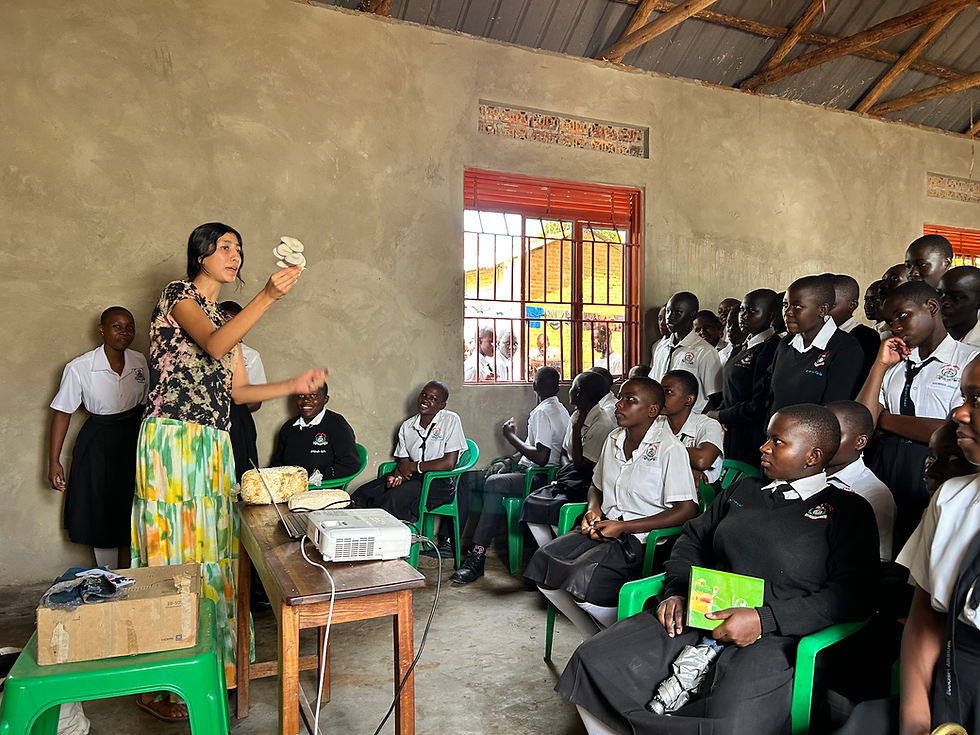
“Despite the conditions many face, we were met with overwhelming kindness and generosity. The festival left many students and farmers inspired to explore working with fungi.”
“Mushroom cultivation should be taught in schools, community training centers and youth innovation programs because it offers nutrition, fast income generation and climate smart farming” continues Jorge Tujay.
Beyond philanthropy and the noble cause of working towards the ending of human suffering, there is also a huge amount of financial incentive for forward-thinking mycopreneurs and companies effectively helping to solve urgent and dire challenges in the region. Chinese agritech giant Juncao Technology is already deeply invested in the region providing low-cost cultivation technology and educational training to boost livelihoods and opportunity.
Africa has 1.5 billion people and 3.6 million hectares of tropical forest spread across the continent; the possibility for mushroom innovation to help foster regenerative economic opportunities and climate resilience can not be overlooked, and it should be African citizens themselves leading the way.