Researchers Craft Plastic-Free Food Packaging From Mushroom Mycelium and Cellulose

Too long to read? Go for the highlights below.
Researchers at the University of Maine have combined mushroom mycelium with wood-derived cellulose to create a biodegradable food packaging material that resists both water and oil.
The production process has been compressed from several weeks to just three days, bringing the technology meaningfully closer to commercial viability.
The material can be applied as a coating on paper or formed into a standalone film, offering a versatile, plastic-free alternative for food packaging.
Walk into any supermarket and the sheer volume of plastic wrapping on display is difficult to ignore. Concern is growing: a recent study found that more than a quarter of the 16,000 chemicals used in plastic manufacturing carry risks to human health. Researchers at the University of Maine have responded to this challenge not with synthetic chemistry, but with fungi: producing a packaging material that is water-resistant, oil-proof, and fully biodegradable.
Mycelium Meets Cellulose
The new material combines two natural components: mycelium, the dense, thread-like root network of fungi that grows beneath the visible mushroom, and cellulose nanofibrils (CNFs), extremely fine fibres derived from wood. CNFs are a form of cellulose, the structural polymer found in all plant cell walls, that can be processed into thin, flexible materials with strong barrier properties against grease and oils.

The research team selected Trametes versicolor, commonly known as turkey tail mushroom, a species that grows naturally on decaying wood. This made it a logical pairing with wood-derived CNFs, which the mycelium can actually consume as a nutrient source whilst simultaneously integrating with them to form a coherent film. The fungus is first cultivated separately, then blended with a nutrient-rich broth and the CNFs. During this process, the hair-like filaments that make up the mycelium, known as hyphae, begin small and grow uniformly through the mixture. Once dried, the resulting coating is just 20 to 25 microns thick, roughly a quarter of the width of a human hair.
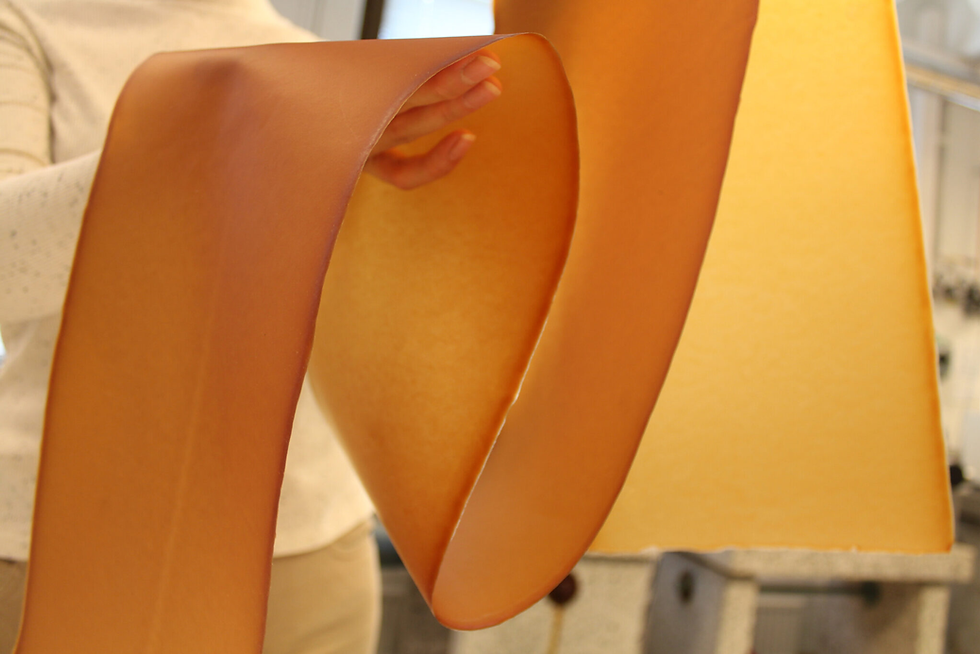
The finished product can either be applied directly onto paper as a surface coating or produced as a self-standing film. One side has a slightly textured, organic feel; the other is smooth and closely resembles conventional plastic film. Both forms offer resistance to water and oils, which are the two principal barrier requirements for most food packaging applications. Mushroom-derived chitosan has previously been explored in similar contexts, though this mycelium-CNF composite represents a distinct structural approach.
From Laboratory to Production Line
One of the persistent obstacles for mycelium-based materials has been the time required to grow them. Traditional cultivation methods demand several weeks before a usable material emerges. The UMaine team, led by Sandro Zier, a doctoral candidate in chemical engineering working under associate professor Caitlin Howell, has managed to reduce that timeline to just three days: a compression that has significant implications for industrial feasibility.

The team is now developing a roll-to-roll processing method, a standard industrial technique in which materials are continuously processed on reels, allowing output to scale from square centimetres per hour to square metres per hour. Such a transition would bring production costs down considerably and align the process with existing manufacturing infrastructure. Mycelium-based composites has attracted substantial investment as multiple industries look for bio-based material solutions.
The Wider Case for Change
The urgency behind this research is not merely academic. The United Nations estimates that between 19 and 23 million tonnes of plastic enter rivers, lakes and oceans every year. Microplastics, tiny particles shed as plastics degrade, are now found in human blood, breast milk and lung tissue. The fact that fungi are already part of the human diet, as Howell notes, offers some reassurance about the long-term safety profile of mycelium-based materials in food contact applications.
The UMaine team's approach sits within a broader movement exploring biodegradable fungal coatings as replacements for plastic across packaging and textiles. Whether turkey tail mushroom eventually lines the shelves of supermarkets remains to be seen, but the biological case for trying is now rather compelling.