Pure Mycelium Steps Into the Spotlight at Milan Design Week With a Functional Fungal Shoe

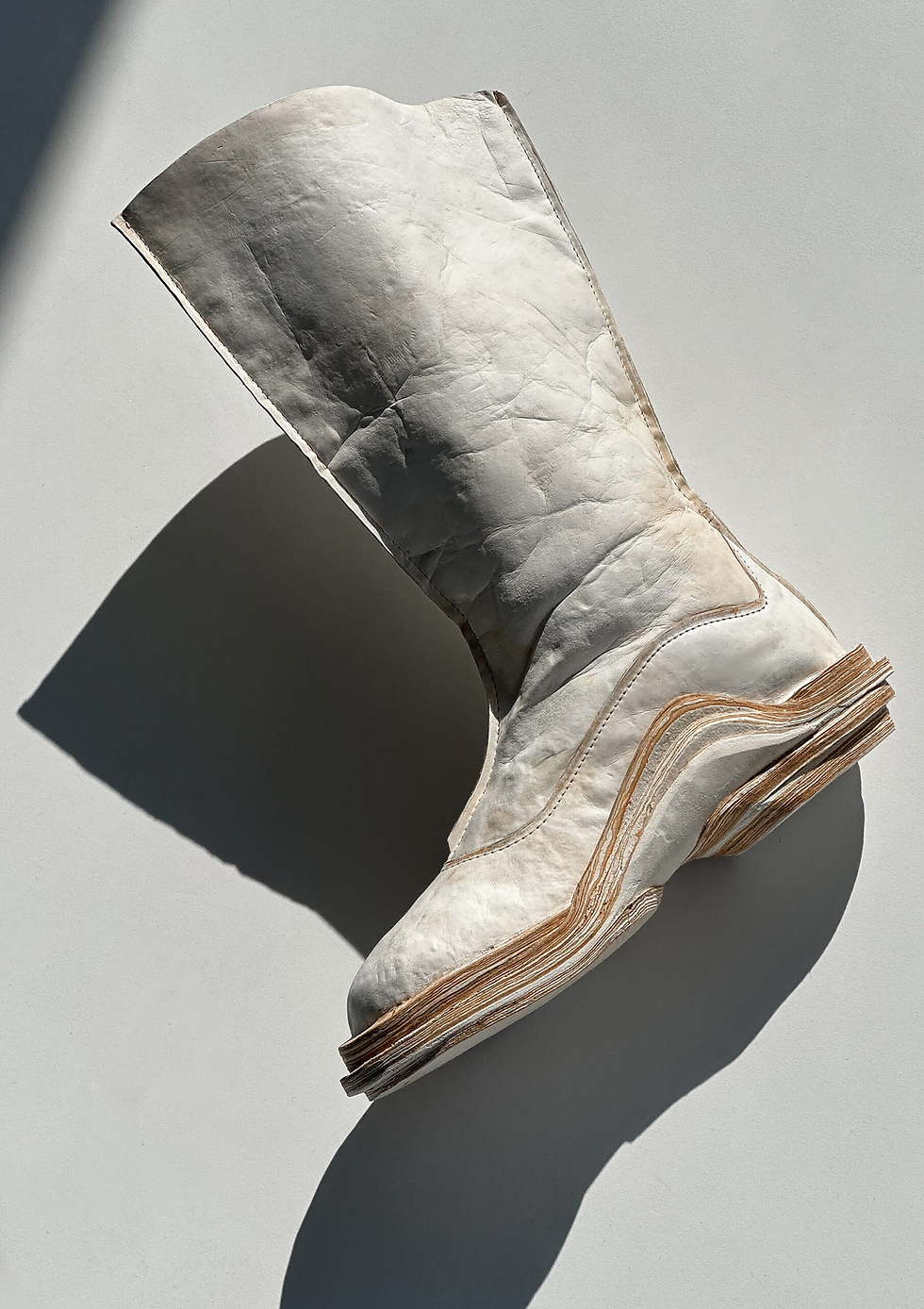
A prototype boot made entirely from mycelium, including a load-bearing sole, has debuted at Milan Design Week, marking a significant step beyond mycelium's typical role as a surface material.
The project combines two-years of fungal materials research from Vrije Universiteit Brussel with traditional shoemaking craft from La Monnaie/De Munt, demonstrating how biology and artisanal skill can be woven together.
The work forms part of the MycoMatters programme, which aims to develop pure mycelium materials with the performance and scalability needed for real-world commercial use.
A prototype shoe made entirely from pure mycelium quietly arrived at Milan Design Week this April. This collaboration between researcher and designer Lars Dittrich of Vrije Universiteit Brussel and head shoemaker Marie De Ryck of La Monnaie/De Munt suggests the answer may finally be moving from theory into something you can stand on.
From Surface to Structure
Most mycelium applications to date have positioned the material as a substitute, typically replacing leather as a surface covering or foam as a packaging layer. This project takes a different approach. The mycelium sole achieves load-bearing capacity without any additional reinforcement, constructed by bonding multiple sheets of fungal material into a single, dense formation. This shift, from decorative or protective layer to structural component, is what distinguishes the work within the broader field of bio-fabricated materials.

When grown on agricultural substrates under controlled conditions and then dried or heat-treated, mycelium can be shaped into lightweight, rigid or flexible materials. The challenge has always been coaxing it into forms that meet the mechanical demands of everyday objects. A shoe sole must bear repeated compressive loads, flex with movement, and maintain structural integrity over time. Achieving this without composite additives or reinforcing scaffolds represents a meaningful technical advance.
Two Strains, One Boot
The team spent two years refining their process through iterative cycles of growth, testing, and adjustment. Selecting the right fungal strains was central to the work. Dittrich identified two species with complementary properties: one produces a foam-like, mouldable material suited to the sole, while the other yields a more elastic, leather-like sheet used for the upper portion of the boot. This strain-specific approach reflects a growing sophistication in how researchers work with fungal biology, moving away from a one-size-fits-all material logic toward deliberate selection based on mechanical requirements.

The research underpinning this builds on work by the Microbiology Research Group at Vrije Universiteit Brussel, led by Professors Eveline Peeters and Elise Vanden Elsacker, and sits within the MycoMatters programme, which focuses on developing pure mycelium materials at the performance and scalability levels required for practical deployment. The boot is framed explicitly as a conceptual object, a demonstration of the current state of the art rather than a market-ready product.
Craft Meets the Laboratory
The design language of the boot makes no attempt to hide its material origins. Exposed seams, layered edges, and visible thickness all articulate the character of the mycelium rather than disguising it. The collaboration revisited traditional sole lamination techniques, adapting them to work with a material that behaves quite differently from cowhide. This dialogue between artisanal knowledge and laboratory research is arguably as significant as the material breakthrough itself. Feedback from the shoemaking process informed how the material was grown and processed, creating a loop between craft intuition and scientific method.

La Monnaie/De Munt's involvement reflects its broader sustainability agenda, a commitment the institution describes as its "Green Opera" strategy, which seeks innovations that can support a more sustainable future for the arts. The project aligns with wider momentum in mycelium-based materials research, where academic groups and designers are increasingly working in tandem to bridge the gap between biological potential and functional application.
Whether pure mycelium footwear will eventually reach consumers remains an open question. What this prototype does establish is that the material's structural capabilities are more developed than most had assumed, and that the conversation between biology, design, and craft is producing results worth watching.