New Study Links Substrate Particle Size to Mycelium Composite Strength

Researchers at the University of Strathclyde found that wheat bran and oat additives gave living Pleurotus ostreatus beechwood composites the highest mean peak compressive stress, at 29.77 and 31.45 kPa.
Of four surface-area measures taken by nitrogen adsorption and X-ray micro-computed tomography, the surface area accessible to fungal hyphae followed the strength ranking most closely.
The authors propose particle-size reduction as a practical processing variable for tuning mycelium composites, though the evidence is exploratory and based on three specimens per group.
The internal structure of nutrient additives may help explain why some living mycelium composites are stronger than others, according to new research from the University of Strathclyde. The work, published in Scientific Reports, comes from Qi Zhang, James Minto, Beatriz Doñagueda Suso and Grainne El Mountassir. They tested six food-derived additives with the oyster mushroom Pleurotus ostreatus and identified particle size as a possible lever for tuning mycelium composites for construction.
Connecting Living Composites and Microstructure
The United Nations Environment Programme estimates that construction and the built environment contribute around 37% of global CO₂ emissions. Mycelium-based composites, which use fungal networks to bind agricultural and forestry by-products, are already used in packaging, fashion, insulation and "mycelium bricks" or even paving, as developed in Denmark by Visibuilt.
Most such materials are heated, and often pressed, to stop growth and to densify them. The Strathclyde team instead studied living, unpressed material that retains an active mycelial network, which they suggest could ultimately inform in-situ geotechnical uses. Earlier work had shown that species, substrate and incubation time all matter; comparatively few studies had examined how composition strategies tune composite properties.

How the Experiment Was Run
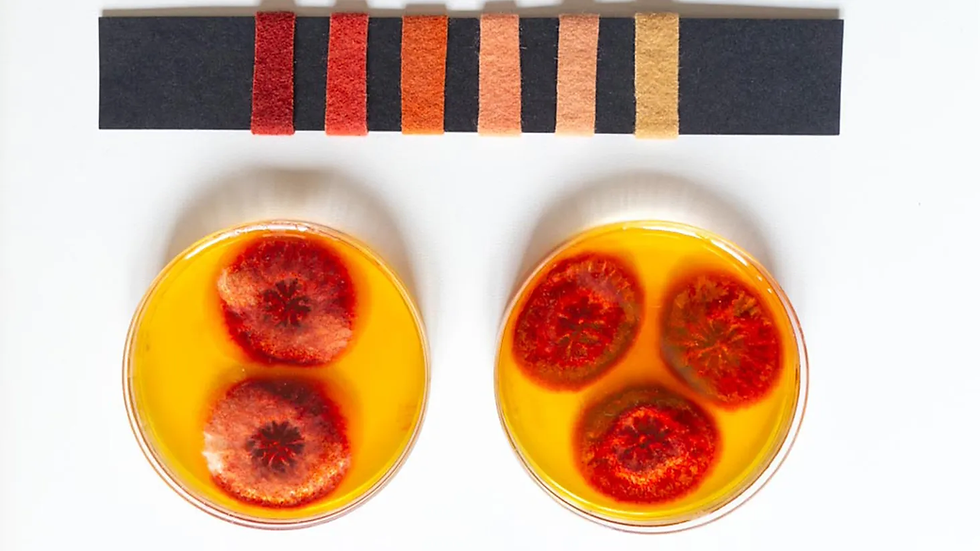
The base substrate was beechwood chips of up to 4 mm. To it the team added 10% by weight of wheat bran, oats, barley, rice, corn or spent coffee grounds. The additives were chosen to have similar carbon-to-nitrogen ratios, particle densities and water retention, so that differences in shape and internal pore structure could be examined. Specimens were incubated at 25°C for four weeks, then crushed in unconfined compression, with three independently prepared cylinders per mixture.
Microstructure was assessed in two ways: nitrogen adsorption (the Brunauer–Emmett–Teller, or BET, method) and X-ray micro-computed tomography at 3.5 μm resolution. From the scans, the team derived total, connected and "hypha-accessible" surface area per unit of solid volume. The last discounts pores smaller than 10.5 μm, a cut-off chosen with reference to reported hyphal diameters of roughly 2 to 10 μm. The authors stress that it is an operational estimate, not a biological threshold.

What the Compression Tests Showed
Mean peak stress across the fungal mixtures ranged from 17.92 to 31.45 kPa, against 21.35 kPa for pure beechwood. Only oats and wheat bran differed significantly from that reference after statistical correction. Corn, coffee, rice and barley did not. Beechwood-additive mixtures without fungal growth collapsed during testing, suggesting that mycelial growth helped maintain their structural integrity under these conditions.

BET surface area alone failed to reproduce the strength ranking, since oats and wheat bran performed well despite low or undetectable values. Hypha-accessible surface area tracked the ranking best, with one notable exception. Spent coffee grounds had the highest accessible surface area, yet their strength was comparable to mixtures with far lower values. Residual coffee oils or caffeine could help explain the unexpected results, although neither was measured directly. Related work on 3D-printed biocomposites from recycled grounds also explores the potential of coffee waste in mycelium-based materials.
Grinding Barley
To test the idea directly, the team ground barley for 30 seconds, shifting particles from 2 to 4 mm down to 0.2 to 2 mm. Hypha-accessible surface area rose from 6.7 to 22.8 mm²/mm³, while total and connected measures changed little. Mean peak stress increased from 22.26 to 28.57 kPa, about 28%.

The paper cautions that grinding also alters packing, particle contacts, nutrient distribution and water interaction, so the comparison does not isolate surface area alone. Particle-size reduction could therefore offer a practical way to tune these materials, although further testing is needed to establish how reliably it improves strength.
Limitations and the Road Ahead
The findings are labelled exploratory. With only three specimens per group, and unreplicated tomography scans, the authors say a causal or quantitative predictive relationship cannot be established. Final moisture content, bulk density and porosity after incubation were not measured, and the petri-dish colonisation screening was qualitative, with one dish per condition. The testing was also limited to unconfined compression of small cylinders after four weeks.
Future work should use larger replicated datasets and measure mycelial network architecture directly. It should also assess tensile and flexural strength, erosion, hydraulic conductivity, durability and behaviour under wetting-drying and freeze-thaw cycles.