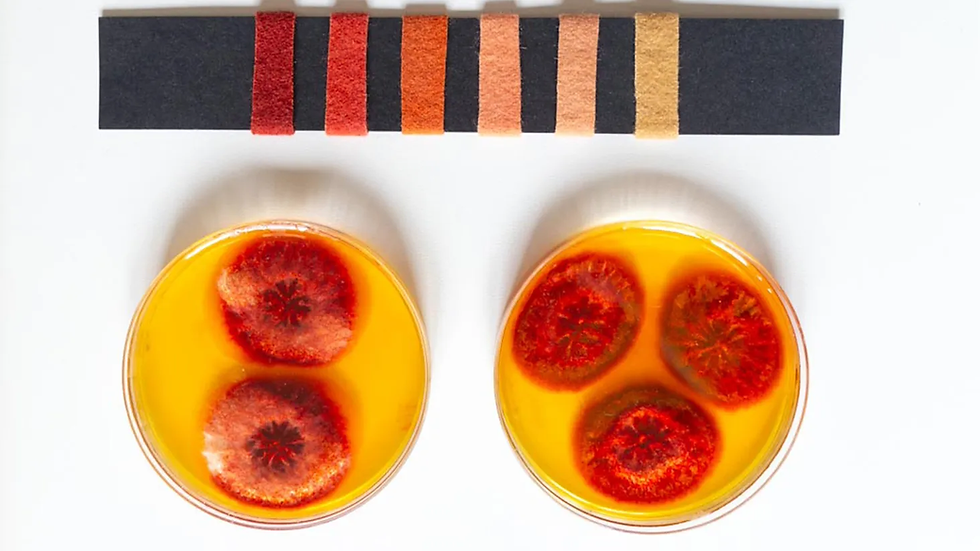
GROWinK: The Mushroom-Based Ink System Designed to Disappear

Graphic design has long operated under an unspoken assumption: that printed materials should endure. Posters weather seasons on hoardings; textiles persist in landfill for decades. Yet the messages they carry are often redundant within days. This tension sits at the heart of GROWinK, a project developed by Peerasin Punxh Hutaphaet, a Thai designer completing the MA Material Futures programme at Central Saint Martins in London.

Punxh's background is in product design, but his practice has shifted towards what he terms "visual ecology", a discipline that considers how graphic communication can function as part of living ecological systems rather than against them. The catalyst was partly mundane: observing British parks after sunny days, littered with discarded printed materials that were fleeting in purpose but essentially permanent in environmental impact.
Fungi and Bacteria as Design Collaborators
GROWinK works by replacing conventional petroleum-based printing inks with pigments derived from fungi, combined with dormant bacterial spores suspended within the ink itself. The system mirrors the familiar CMYK colour model used in standard commercial printing—cyan, magenta, yellow, and black, but substitutes synthetic chemistry for biology.

When printed materials are discarded into humid environments or landfill conditions, the dormant spores activate. The microorganisms then begin breaking down the substrate, particularly synthetic materials such as polyester, digesting them into compounds that can reintegrate with the soil. In effect, the printed graphic becomes a temporary artefact, designed with its own end-of-life built in from the outset.
This approach draws on the well-established capacity of fungi and bacteria to decompose complex organic and synthetic matter, a process that researchers are increasingly exploring across biodegradable material applications in packaging and textiles. The organisms act not merely as pigment sources but as active agents in a material's lifecycle.

Designing Processes, Not Objects
What makes GROWinK conceptually distinct is its framing of the designer's role. Rather than engineering a stable end-product, Punxh positions the designer as a collaborator with living systems—someone who sets biological processes in motion and allows decay and transformation to become part of the designed outcome. Growth, degradation, and nutrient return are not failures of the material; they are its intended function.
This thinking aligns with a broader shift in material innovation, where biofabrication increasingly invites designers to work with living organisms rather than simply processing inert matter. Fungi in particular offer a compelling model: they are simultaneously architects and decomposers, capable of building intricate structures and dismantling them with equal efficiency.

GROWinK remains a research project at present, developed within an academic context. Translating the system into scalable commercial printing would require considerable further development controlling spore activation reliably outside laboratory conditions being among the more immediate challenges. Nevertheless, the project raises a question that the creative industries have been slow to address: if a message is temporary, why should its medium be permanent? Punxh's answer, characteristically, involves fungi.