


Mycorrhizal Fungi Deep Dive: The Unseen Half of Britain’s Temperate Rainforests
Too long to read? Go for the highlights below.
A large-scale DNA study across Britain's temperate rainforests is mapping mycorrhizal fungal diversity for the first time, revealing these ancient woodlands as overlooked biodiversity hotspots.
The popular "wood-wide web" metaphor oversimplifies reality—forests are not unified networks but complex ecosystems where hundreds of fungal species compete and cooperate in distinct micro-territories.
A single tree can harbour dozens of fungal species across its root system, and growing just one porcini mushroom requires an estimated 3–14 million root-fungus connections and 1,800 kilometres of fungal threads.
The wood-wide web - the idea that mycorrhizal fungi connect all trees in a forest in a singular, unified network - is an attractive story, but it’s a misconception. Imagining mycorrhizal networks as a kind of earthly internet that allow “plugged-in” trees to send and receive nutrients has gained widespread attention, but as with many things in ecology, the truth is far more complex.
And far more interesting too.
*
Along the western fringes of the British Isles, the last fragments of temperate rainforest quietly persist along rainy coastlines, misty upland hills and rugged boulder-strewn valleys.
In Britain, our rainforests have a uniquely gnarled, fairytale-like and Tolkien-esque character to them, like much of the stories, myths and legends they’ve inspired throughout our cultural history.

Although Britain’s fungi are well studied, it’s temperate rainforests remain one of the least studied habitats for fungal wildlife.
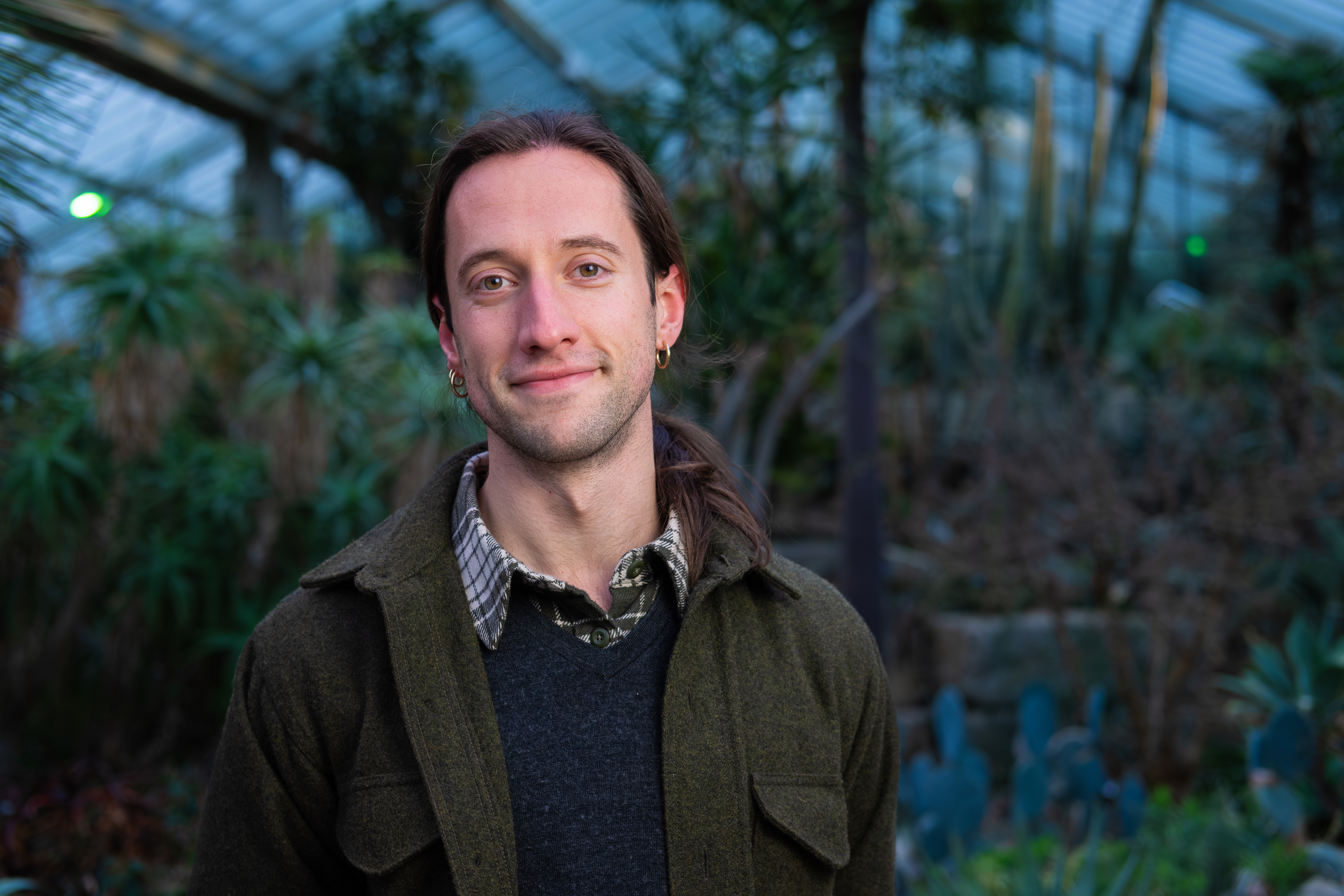
David Satori, mycorrhizal ecologist at the Royal Botanic Gardens, Kew, Imperial College London and Forest Research, is addressing this gap in our knowledge by undertaking a large-scale, systematic study of fungal diversity in temperate rainforests.
In an ambitious effort to map the diversity of mycorrhizal communities found in Britain’s rainforests, David has been collecting and sequencing the DNA from mycorrhizal roots and soil samples across Britain’s entire rainforest zone - from the coastal hazelwoods of northwest Scotland, to the ancient, dwarfed oakwoods of Cornwall.

Over several years conducting surveys as a field mycologist in Britain’s rainforest region, he noticed how little understanding there was of this habitat’s fungal species. So, he designed a research project to address this gap in knowledge, bringing light to the unseen species that have sustained Britain’s rainforests for millennia.
*
Woodlands are important mycorrhizal habitats. In the Northern Hemisphere, much of a woodland’s canopy is composed of trees that form ectomycorrhizal relationships. The prefix “ecto-” means “outside” or “external” and simply refers to what the fungal-root interface looks like. The fungi form a sheath on the outside of a root tip, like a glove on a finger. This “fingered glove” is called an ectomycorrhiza.


Inside this sheath, fungal hyphae grow between root cells and form a Hartig net that acts as the zone where nutrients are exchanged.

You can sometimes identify a species by their ectomycorrhizas. For example, milkcaps (Lactarius, Lactifluus) often have very smooth, yellow-orange ectomycorrhizas. When you zoom in on them with a high-magnification lens, you can see their entire surface criss-crossed by fine white lines. These are lactifers, the veins carrying the milky latex that seep out of their mushrooms when broken.

In others, you can see thicker threads coming out of the ectomycorrhiza. These are rhizomorphsdesigned to efficiently transport nutrients across several metres.

Oftentimes you can see multiple species coexisting on the same root, like in the photo below that shows a multi-coloured cluster of ectomycorrhizas, each colour being a different species.

These ectomycorrhizas - being the interface that receives sugars from their tree host - and the hyphae that forage for nutrients in the soil are what fuel the growth of mycorrhizal mushrooms in autumn. It has been estimated that it takes between 3-14 million ectomycorrhizas and 1,800 km of hyphae to gather enough nutrients to grow one Porcini (Boletus edulis) mushroom.

*
A single mycorrhizal individual may occupy less than one square metre of woodland soil, and a single tree may harbour dozens of fungal species made up of hundreds of genetic individuals, all occupying their own little space across the tree’s root architecture.
This hidden half of a woodland isn’t a unified network; it’s an organic constellation of hundreds of species and countless individual fungi. Each species has their own strengths and specialisms: some are particularly good at foraging for minerals directly from rock, some are good at transporting nutrients long distances through rhizomorphs, and others may have retained a small capacity to break down woody plant debris like the decomposer fungi they evolved from.
A woodland is more like a busy and crowded mycorrhizal metropolis. Each fungal individual is embedded in networks of cooperation and competition, seeking to obtain nutrients and fulfil their life cycle, rather than a uniform web.
The mycorrhizal underground is just as complex and full of character as any ecosystem we study aboveground.

Knowing that a single small patch of forest can harbour dozens of species - some of which might only be found in that one single patch - makes it all the more important to protect existing core areas of temperate rainforest and help regenerate new areas to give rare species a fighting chance at survival.
After all, one of the most important factors that influences the fungal diversity of a woodland is how big it is.
*
David’s photographs of ectomycorrhizas have captured the imagination of people across the world on social media, universities and schools, and even the Houses of Parliament.
After many years of abstract metaphors being used to describe mycorrhizal networks, David’s photographs offer a truthful glimpse into the nature of mycorrhizal life. He hopes his work will bring understanding to the complexity of mycorrhizal ecosystems, breaking down misconceptions and making them more relatable.
Through his research, he maps the diversity of mycorrhizal fungi, identifying biodiversity hotspots that need the most protection. This will help meaningfully integrate mycorrhizal fungi into conservation plans, inform environmental policy, and design strategies that restore the below-ground ecosystems of Britain’s lost rainforests.
You can discover more of David’s photography and work by following his posts on LinkedIn, Instagram @rewilding_mycology and his website, Rewilding Mycology.

