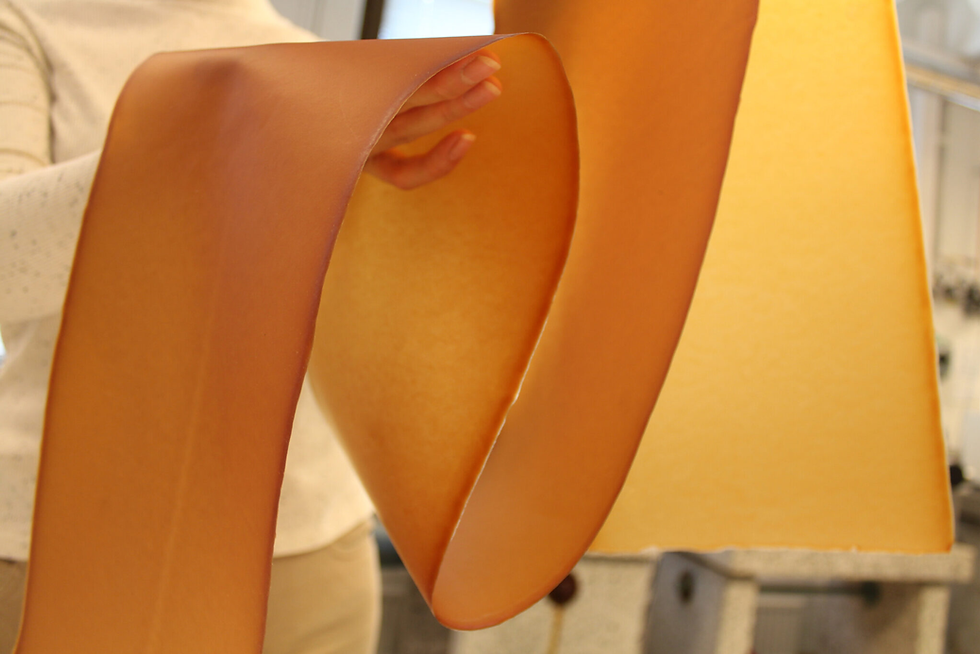
Visibuilt Raises €3 Million to Scale Mycelium-Based Construction and Pavement Binder

Danish biotechnology company Visibuilt has closed a EUR 3.34 million seed round to advance visiBINDER, a mycelium-based alternative to conventional carbon-intensive construction binders such as bitumen and cement.
visiBINDER is produced from mycelium and is designed to meet the durability requirements of paving and infrastructure applications while reducing embedded carbon compared to fossil-derived binders.
The investment will fund larger-scale production trials and industry validation, with Visibuilt already reporting active testing relationships with Denmark's leading concrete paver manufacturer and Copenhagen Municipality.
A Carbon Problem Embedded in Every Road
Concrete and asphalt production rank among the largest sources of CO₂ emissions globally. The binders that hold these materials together, primarily bitumen, a petroleum derivative, and cement, are energy-intensive to produce and difficult to substitute without sacrificing performance. Most efforts to decarbonise construction have focused on the buildings themselves; the roads, paths, and paved surfaces beneath them have attracted considerably less attention.
Visibuilt, a Copenhagen-based biotechnology company founded by Line Kloster Pedersen and Oleksii Rebrov, is targeting this gap. The company is developing visiBINDER, a biobased construction binder produced from mycelium, the dense, thread-like root structure of fungi. The technology is designed for paving and infrastructure applications, sectors where performance standards are demanding and the tolerance for unproven materials is low.

The Seed Round and Its Backers
On 15 July 2026, Visibuilt announced it had secured EUR 3.34 million in seed funding. The round was co-led by EIFO, Denmark's state-owned investment and export financing institution, and Unconventional Ventures, an impact-focused venture capital fund investing across Nordic and European markets. Proptechfonden, a Copenhagen-based venture capital fund focused on construction and real estate technology, also participated, as did EMDFonden, a Danish commercial foundation that had backed Visibuilt in an earlier round.
Unconventional Ventures described the rationale for co-leading in terms of structural alignment between commercial and environmental outcomes: each tonne of visiBINDER placed in a paving application, the firm noted, displaces a tonne of fossil binder, generates royalty revenue, and reduces the embedded carbon of the infrastructure it goes into. EIFO framed its participation around the broader challenge of decarbonising heavy industry, noting that new solutions in sectors such as concrete and asphalt production are necessary for meaningful emissions reductions.

Visibuilt's CEO, Line Kloster Pedersen, described the closing of the round as an important milestone, enabling the company to mature its technical platform and validate the solution at larger scale ahead of market introduction.
From Laboratory to Infrastructure
Visibuilt's approach sits at the intersection of biotechnology and materials science. visiBINDER is produced from mycelium, which, when grown on agricultural or other organic substrates, forms a dense, cohesive matrix. The company claims its technology is designed to be less energy-intensive than conventional binder production while meeting the durability and performance requirements of outdoor paving applications.

The company has already established testing relationships with Denmark's leading concrete paver manufacturer and with Copenhagen Municipality, a notable degree of industry engagement for a hard-tech company at seed stage and without a fully finalised production setup. Mycelium-based materials have attracted growing interest across construction and infrastructure sectors, though most commercial activity to date has concentrated on interior applications such as insulation panels and packaging rather than outdoor, load-bearing uses.
The new capital will be directed towards expanding testing and validation activities, establishing the production infrastructure required for larger-scale trials, and building out the technical and commercial team. The stated goal is to demonstrate the technology in real-world applications and prepare for eventual market introduction.

What Remains to Be Demonstrated
Visibuilt is at an early stage of commercial development. visiBINDER has not yet been validated at the scale required for road or infrastructure deployment, and the company has not disclosed data on comparative performance benchmarks, production costs, or carbon accounting relative to bitumen or cement. The funding round is explicitly intended to generate that evidence through larger-scale trials and industry partnerships.

The construction materials sector is notoriously conservative; regulatory approval processes, procurement cycles, and infrastructure asset lifetimes create long lead times between technological demonstration and widespread adoption. Whether mycelium-derived binders can meet the full range of mechanical, thermal, and durability requirements imposed by outdoor paving environments remains an open question, and one that the coming validation phase is designed to begin answering. Earlier mycelium construction ventures have demonstrated proof of concept; translating that into certified, scalable products is where the harder work begins.