


Researchers Build Living Mycelium Sheets From Turkey Tail Mushroom

Too long to read?
Researchers at Harbin Institute of Technology report flexible, living mycelium sheets made from Trametes versicolor that bend reversibly with humidity and can regrow after drying.
Soaking a naturally two-faced fungal membrane in polyvinyl alcohol and glycerol raises its flexibility, and the layers swell by different amounts, which makes the sheet bend.
The authors show a proof-of-concept humidity switch and a regeneration route, but the work is laboratory-scale and the carbon-footprint gains depend on replacing the synthetic polymer.
Researchers at Harbin Institute of Technology have developed living mycelium actuators: flexible fungal sheets that bend in response to humidity while the organism inside stays viable. The work, published in Nature Communications by Rui Nie, Xiaoman Liu, Xin Huang and colleagues, addresses a trade-off the authors call fundamental: living attributes such as self-renewal typically preclude the mechanical robustness that practical materials need.
From Fungal Membrane to Flexible Sheet
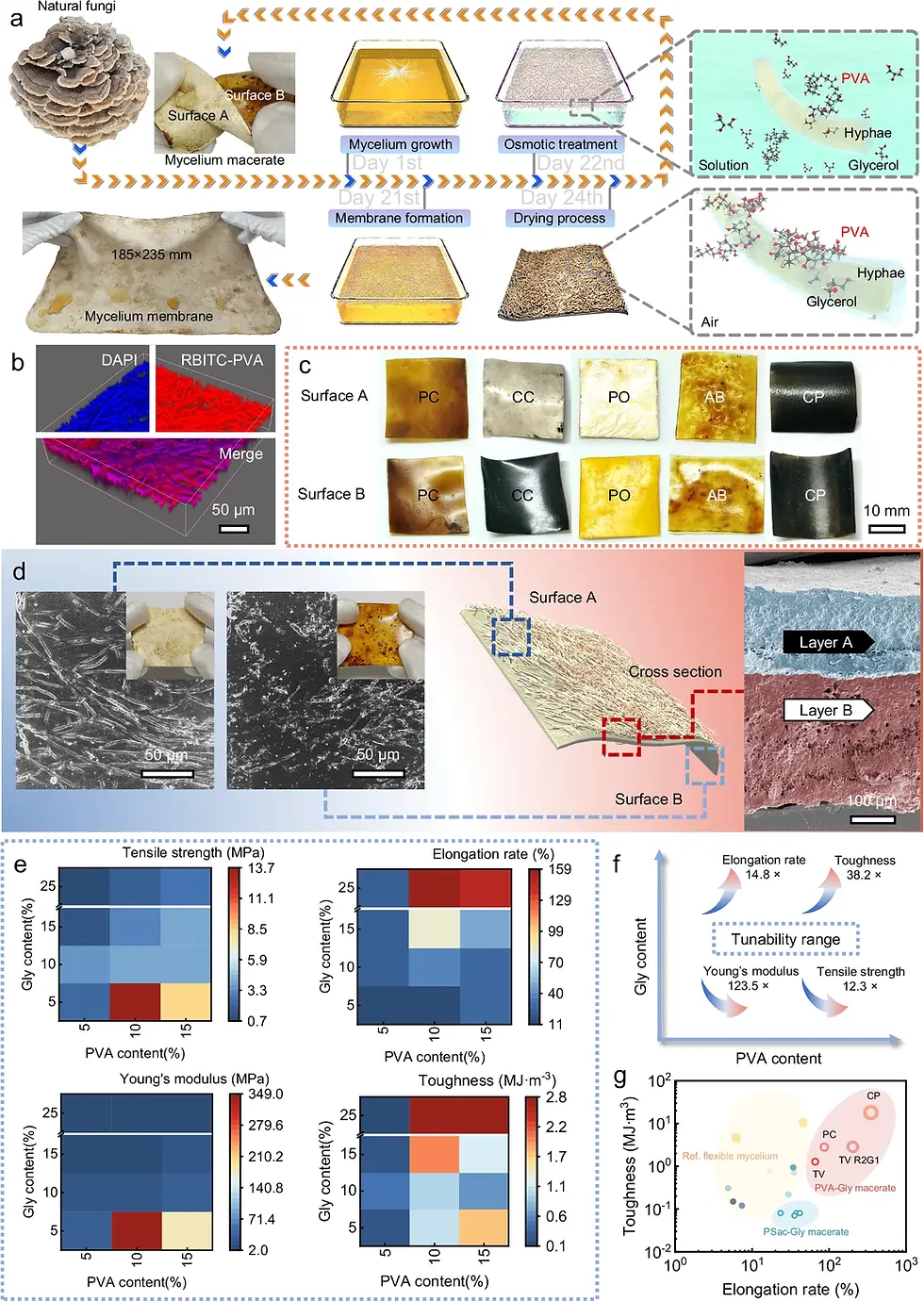
The team grew Trametes versicolor by liquid state fermentation, a still culture in liquid medium, for 20 days at 28 °C and 85% relative humidity. The fungus forms a membrane at the air-liquid interface with a natural Janus structure, meaning two faces with different properties: an air-exposed, hydrophobic top layer of aerial hyphae (layer A) and a hydrophilic bottom layer of nutritive hyphae (layer B).
Dried untreated, the membrane is brittle. The researchers soaked it for 24 hours in polyvinyl alcohol (PVA) and glycerol, then dried it. According to the paper, PVA strengthens the hydrogen bond network among the fungal biopolymers, while glycerol helps the polymer chains slide. The authors call the product a macerate and say it preserves cell viability and the Janus structure.
The optimised sample, with 10% PVA and 10% glycerol, had a Young's modulus of 23.7 MPa, 36% elongation at break and toughness of 1.0 megajoule per cubic metre. Across formulations and species, the authors report elongation of 11% to 349% and toughness of 0.1 to 18.0 megajoules per cubic metre, which they describe as the highest values reported among flexible mycelium materials. A black yeast-like Cladophialophora species gave the top figures. Five other fungi also yielded Janus sheets, and Pleurotus ostreatus bent the opposite way to Trametes versicolor under humidity, which the authors take as support for species-based tailoring.

Why the Sheets Bend
Layer A swells more than layer B. Micro-computed tomography put bulk moisture expansion at 9.27% in layer A against 3.38% in layer B. The authors attribute bending to asymmetric hygromechanics and to entropy-driven reorganisation of the cell wall polymers. Molecular dynamics simulations are consistent with this, though the authors stress that the model is a simplified view of the cell wall.
Over five cycles at 25 °C and 85% relative humidity, the material took up an average of 374.9 milligrams of moisture per gram. Equilibrium bending angles ranged from −19.0 ± 10.3 degrees to 43.2 ± 10.7 degrees, depending on geometry and composition. A flower-shaped actuator opened under humidity, though recovery was slower than deformation because adsorption and desorption rates are unequal.
A Humidity Sensor That Switches a Fan
The group bonded a commercial strain gauge to the sheet and read it with an Arduino microcontroller. As humidity rose, output voltage climbed. At around 60% relative humidity, which matches the critical humidity seen in sorption tests, it reached roughly 1.7 volts, enough to trigger a relay and start a fan. Airflow then dried the sheet, it recovered its shape and the fan switched off. The authors present this as a proof of concept.
Electrical resistance also fell with moisture. Surface A showed a 25.51% greater drop than surface B, and resistance change after 60 seconds tracked relative humidity linearly (R² = 0.943), though the signal deviated from linearity at high humidity. The response operates on a timescale of minutes by design, which the authors say filters out short humidity spikes and suits long-term exposure monitoring rather than real-time control.
Dormancy, Regrowth and Carbon
The fungal cells survive drying. After three months of desiccation, samples placed on agar plates began regrowing from day five and covered the plate within 10 days; staining and MTT assays indicated metabolically active cells with functional mitochondria. The authors say dry storage should stay within one year to keep spores viable. Fragments could be regrown into new membranes, and the Janus structure was inherited through the third generation, although mechanical performance gradually declined. A further recycled generation exceeded 200% elongation.
The study sits within the wider field of engineered living materials. Related work covers fungal scaffolds for living building materials and mycelium cellulose integration for water-resistant textiles.
A cradle-to-gate life cycle assessment, run in SimaPro with the Ecoinvent database and the IPCC 2021 GWP100 method, led the authors to conclude that the carbon footprint of PVA-modified material could fall through optimised PVA loading and bio-based alternatives. Natural polysaccharides such as carboxymethyl cellulose and pectin could replace PVA, but with compromised mechanical performance. The assessment excludes transport, use and end of life.
Limitations and the Road Ahead
The evidence is laboratory-scale. Fabrication used sterile conditions, sensor demonstrations were bench-top, and the paper reports no scale-up economics. The molecular model is simplified, recovery after humidification is slow, and the authors say bio-based replacements for PVA still need work to match mechanical performance. This article draws on the main paper only; the supplementary data, including the life cycle figures, were not available for review.


