


Embodied Mycology: Where Science Meets Intuition
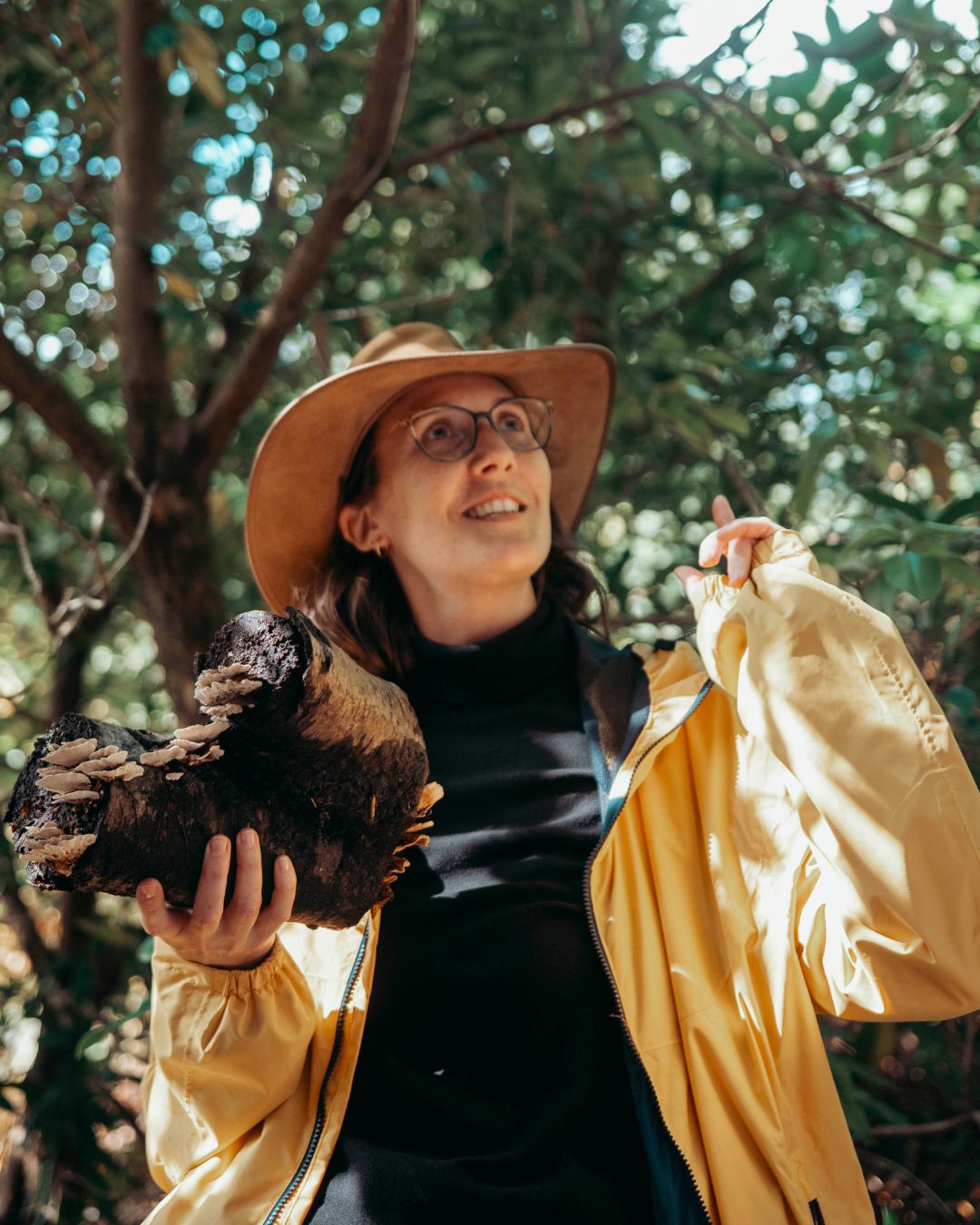
Science and intuition don't have to oppose each other when engaging with nature. An experience can be meaningful without fully understanding it, and as I have discovered, curiosity about an experience can spark scientific exploration.
I'm a biologist by qualification, but I also trained as a crystal healing practitioner in my early twenties. Not necessarily two qualifications you'd expect to find on the same CV. Part of the training involved learning to sense subtle sensations in the body and becoming curious about what we felt when “tuning in” to our crystals and clients. I've sometimes felt that acknowledging one side of myself risks undermining my credibility in the other, and for that reason, I've largely kept my energetic work to myself.

But I've come to realise that separating these two sides of myself means overlooking the very experiences that have shaped my relationship with the natural world, none more so than one rather peculiar encounter with a mushroom.
I'd been going through a particularly difficult period in my life and had reached a point where I didn't have a clue how I was going to heal myself this time. In my desperation, I turned to my higher self, my guides, or what some might call a higher power, and asked, "What should I do now?" I was met with a rather underwhelming response. "Go for a walk."
I'd like to think that this was divine guidance, but maybe my body just knew what I needed, in order to be well. Either way, I like to think that moment is what brought me closer to who I am today.

I hated walking in the rain; this wasn't going to be fun. I had a rotten cold, and all I wanted to do was drown my sorrows. I packed up my things and travelled to a field my friend and I had walked to earlier that week, searching unsuccessfully for magic mushrooms, a commonality I've learned to accept. As I pulled into the car park in the drizzly rain, I wondered why I had chosen "the wettest day" of the year to do my mental health walk. Reluctantly, I dragged myself out of the car.
As I attempted to climb over a rickety fence, it promptly gave way beneath me, tipping almost horizontally and very nearly catapulting me headfirst into a field of bullocks. I concluded the universe wasn't content to send me out in the rain; it wanted to see what I was made of. Having narrowly avoided an undignified introduction to the local livestock, I trudged across the pasture towards a small patch of woodland, wet, disappointed and increasingly suspicious of divine guidance.
Upon entering the woodland, I was met by a row of birch trees, and I noticed an enormous, bulbous growth clinging to the edge of one of the younger birch trees. As I idled toward it for a closer look, I felt my body begin to tingle. Without question, I sat down next to it, closed my eyes, and waited to see if I would feel anything else.
That evening, I shared my discovery on Mushroom Spotters UK, a fantastic resource for beginners to share their finds and receive identification support from more experienced mycologists, though I kept the tingling to myself.. It turned out my mushroom wasn't particularly rare or special. There's an unspoken rite of passage among mycologists: discovering a rare species, or even one new to science. You get a badge for that kind of work!

But one comment caught my attention. A member mentioned that the fungus had historically been used medicinally. My eyes widened. I had woken that morning feeling awful, asked the universe to guide me towards what I needed, and ended the day sitting beside a fungus with a history of medicinal use. Coincidence, perhaps? My subsequent digging around on Google Scholar revealed that birch polypore had shown antiviral potential in experimental studies. None of this proved it could treat my ailment, of course, but it was enough to make me unquenchably curious.
Little did I know that the simple act of sitting and being present with a mushroom would become the foundation of a personal practice I still explore today.
I began visiting fungi, sitting with them, slowing down and paying attention to the sensations they evoked. When I returned home, I'd bury myself in research papers, looking for parallels between what I'd experienced, what I felt I needed and the molecular activity of the fungus I'd encountered. It wasn't until I shared my experiences with my friend Jesper Launder, a fellow mycologist and medical herbalist, that the connection began to dawn on me. He pointed out that I was working much like a herbalist would. Later, whilst working alongside herbalists at Hifas da Terra, I discovered that they engaged with the plant kingdom in much the same way. Unbeknownst to me, I'd been working like an intuitive herbalist all along, just without the training, and with fungi rather than plants.

I bring this same curiosity to my experiences with the Psychedelic Society. While fungi are at the heart of our walks, I encourage participants to slow down, notice the forest's subtleties and immerse themselves in its colours, scents and textures. I've come to believe that understanding fungi doesn't have to begin and end with what we can identify, measure or explain. Sometimes, simply paying attention can lead us towards questions we might never otherwise have thought to ask. It's a form of embodied learning that encourages us to become more aware of our surroundings and the things we might otherwise overlook.
There's no promise of instant enlightenment, just an invitation to slow down, pay attention and see what happens. Preferably without being catapulted into a field of bullocks.
The Female Forager is running an embodied mushroom foraging event in collaboration with the Psychedelic Society on the 24 October and 7 November 2026 in West Sussex. Further details are available here.


