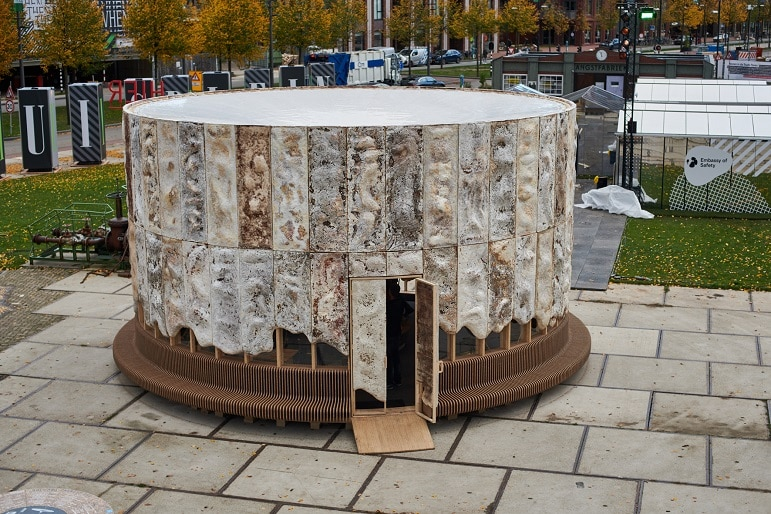
Living Building Materials: How Fungi and Bacteria Create Self-Healing Architecture
- Marc Violo

- Feb 3
- 3 min read
Too long to read? Go for the highlights below.
Engineered Living Materials combine fungal mycelium with biomineralising bacteria to create construction materials that sense environmental conditions, self-repair, and maintain viability for extended periods
Montana State University researchers demonstrated biocomposites inspired by bone structure that remained alive and responsive for nearly one month at 30°C
Multistrain systems outperform single-organism materials by distributing functions like sensing, mineralisation, and structural formation across complementary microbial species
Buildings have functioned as static shelters throughout human civilisation. Engineered Living Materials (ELMs) propose a fundamental departure: construction materials that respond to environmental changes, repair damage autonomously, and evolve over time. Whilst experimental microalgae facades demonstrated living-organism integration in architecture, a new generation of materials combines multiple microbial or fungal species to achieve sophisticated behaviours impossible with single organisms.

From Bone-Inspired Structures to Bio-Cement
The most compelling multistrain ELMs pair fungal mycelium with biomineralising bacteria. Mycelium provides a shapeable, lightweight network (the structural scaffold) whilst bacteria catalyse bio-cement formation through calcium carbonate precipitation within this fibrous matrix. This division of labour mirrors natural systems like bone, coral, and soil ecologies, which derive resilience from both cooperation and redundancy.
Researchers from Montana State University and partner institutions created biocomposites using Neurospora crassa mycelium and Sporosarcina pasteurii bacteria. Inspired by cortical bone's internal architecture, the team fabricated biomineralised scaffolds with similar microstructure of concentric rings centred around internal channels that facilitate nutrient transport.

The bacteria effectively biomineralised the mycelium matrix, increasing composite mass whilst the material demonstrated high viability, remaining alive and responsive for nearly a month at 30°C. This extended viability represents significant progress, as most ELMs begin degrading within weeks due to nutrient depletion, microbial competition, or desiccation.
Hydrogel Matrices and Programmable Responses
Another trajectory involves infusing polymer hydrogels (gelatinous, water-loving substances) with engineered microbes. These hydrated matrices provide optimal environments for living organisms whilst enabling nutrient and gas distribution. MIT engineers developed ELM hydrogels containing multiple strains of engineered E. coli, each performing distinct functions: detecting environmental toxins like heavy metals, releasing protective enzymes, or exhibiting colour changes signalling contamination.
These varied roles cannot be easily performed by single strains. Architecturally, hydrogel ELMs could enable smart membranes or bioskins responding to pollutants or self-regulating porosity based on climatic fluctuations which creates programmable materials adapting to environmental conditions.

Metabolic Interdependence and Resilience
The most sophisticated multi-strain ELMs feature mutually auxotrophic microbial populations- meaning organisms metabolically depend on one another for essential nutrients including vitamins, enzymes, and amino acids. This mutualistic relationship enhances material resilience and endurance.
Under environmental stresses like heat, dryness, or salinity, some microbes become dormant whilst others remain active to protect the system. Roles reverse as circumstances change. Research by the Swiss Federal Institute of Technology Lausanne and other laboratories determined such ELMs outlast monocultures even under changing conditions.

Materials that self-stabilise and evolve under stress prove desirable for construction applications. Facade systems or subterranean contexts experiencing challenging conditions would benefit from materials requiring occasional recharging via light or moisture rather than frequent maintenance or replacement.
Commercial and Regulatory Challenges
Despite progress, commercialisation faces substantial hurdles. Long-term viability remains limited: most ELMs degrade within weeks or months. Realising self-sustaining multistrain ecologies requires significant innovations in metabolic engineering and material design.
Biosafety presents another challenge. Although most strains are non-pathogenic, regulators will likely demand strict controls preventing potential contamination or unrestrained microbial growth. Building codes and performance standards currently lack frameworks for evaluating materials that grow, mutate, and evolve. Public acceptance of biological building surfaces remains uncertain.
Nevertheless, as climate volatility accelerates and traditional passive building products degrade under increasing stress, living materials detecting changing circumstances and responding through self-repair offer tangible benefits. Future material assemblies may not merely be specified but cultivated, with modular microbial toolkits offering functional strains selectable for particular functions: pollution detection, crack repair, UV resistance, or carbon sequestration.
Multistrain ELMs invite reimagining architecture not as assemblages of inert products but as living ecosystems: responsive, regenerative, and adaptive, albeit uncanny participants in the constructed environment.